
Business
Resolve maritime disputes at home to unlock blue economy, Oyetola urges judiciary
By Ezurike Ugochukwu
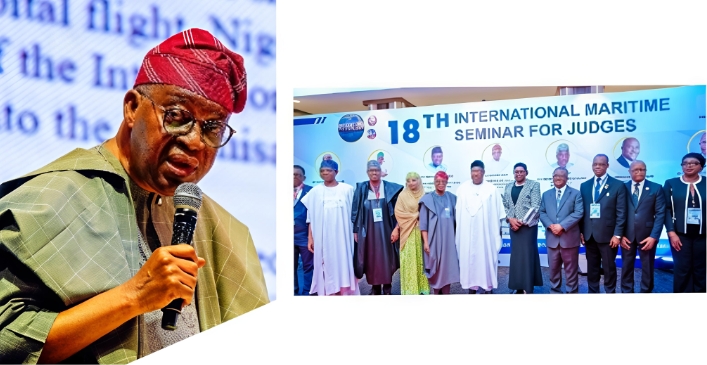
The Minister of Marine and Blue Economy, Adegboyega Oyetola, has called for the prompt resolution of maritime disputes within Nigeria, saying strengthening the country’s admiralty justice system is critical to unlocking the vast opportunities in the blue economy.
Speaking at the opening of the 18th International Maritime Seminar for Judges in Abuja, Oyetola said Nigeria must build a judicial system that inspires confidence among investors, shipowners, insurers and international trading partners.
He stressed that positioning Nigeria as Africa’s preferred maritime investment destination cannot be achieved if the country’s maritime ambitions cannot be achieved if major shipping disputes continue to be settled in foreign courts and arbitration centres.

 According to the minister, a strong and commercially responsive maritime judiciary is no longer merely a legal necessity but an economic imperative capable of attracting investment, lowering the cost of doing business and strengthening Nigeria’s competitiveness in global shipping.
“Nigeria cannot aspire to become Africa’s preferred maritime hub while complex shipping disputes continue to be routinely resolved in foreign jurisdictions through litigation or arbitration. The strengthening of our admiralty jurisprudence is therefore an essential pillar of our national economic strategy,” Oyetola said.
He noted that every maritime judgment delivered by Nigerian courts sends a powerful signal to the international business community regarding the country’s legal certainty and investment climate.
“A predictable, well-reasoned and internationally informed judiciary is itself an instrument of economic competitiveness. It lowers transaction costs, enhances commercial confidence, encourages parties to choose Nigerian courts and arbitration centres for the resolution of maritime disputes, and reinforces Nigeria’s reputation as a credible destination for maritime investment,” he stated.
The minister explained that while the Federal Government has continued to implement far-reaching reforms across the maritime sector, including port modernisation, improved maritime security and the development of the National Policy on Marine and Blue Economy, those initiatives would only achieve their full potential if supported by an efficient and trusted legal system.
According to him, infrastructure development alone cannot guarantee sustainable growth in the maritime sector without a judiciary capable of resolving disputes quickly, fairly and professionally.
Oyetola highlighted some of the government’s recent achievements, including the approval of the disbursement of the Cabotage Vessel Financing Fund (CVFF), Nigeria’s return to Category C membership of the International Maritime Organization (IMO) Council, the generation of more than ₦1.8 trillion in revenue by maritime agencies in 2025, and the country’s sustained piracy-free status within its territorial waters for four consecutive years under the Deep Blue Project.
He also disclosed that the Federal Government had secured a £746 million financing agreement with the United Kingdom for the rehabilitation and modernisation of Apapa and Tin Can Island ports.
 Looking ahead, the minister urged judicial officers to equip themselves for emerging legal challenges arising from technological innovations transforming global shipping.
He identified autonomous ships, blockchain-enabled cargo documentation, electronic bills of lading, artificial intelligence, digital shipping systems and maritime decarbonisation as areas that would increasingly generate complex disputes requiring specialised judicial knowledge.
“The maritime legal landscape is undergoing profound transformation globally, and Nigeria must not be left behind. It is imperative that our judicial officers continue to update their knowledge and remain abreast of emerging developments in maritime law,” he said.
To strengthen the country’s legal framework, Oyetola reaffirmed the Federal Government’s commitment to expanding specialised maritime divisions within the Federal High Court, aligning Nigeria’s maritime laws with international conventions, deepening collaboration between maritime agencies and the judiciary, and promoting maritime arbitration as a faster and commercially efficient dispute resolution mechanism.
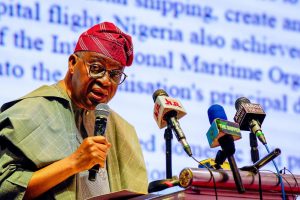 The minister made the remarks at the opening of the 18th International Maritime Seminar for Judges, organised by the Nigerian Shippers’ Council in collaboration with the National Judicial Institute. The annual seminar, established in 1995, has become Nigeria’s foremost platform for enhancing judicial capacity in maritime law and admiralty practice.
The seminar brought together judges, maritime law experts, arbitrators, regulators and industry stakeholders from Nigeria and other West African countries to deliberate on emerging issues in maritime law, improve the quality of maritime adjudication and strengthen the legal framework needed to support the country’s blue economy aspirations.
Oyetola maintained that resolving maritime disputes efficiently within Nigeria would not only reduce dependence on foreign jurisdictions but also enhance investor confidence, accelerate trade, promote legal certainty and unlock the enormous economic potential embedded in the nation’s marine and blue economy.










Ogun LG chairman hails Idiroko Customs football initiative, seeks professional pathway for border talents

Nigeria Customs, Benin, Cameroon advance one-stop border initiative after Zimbabwe Mission

Kogi mourns Rear Admiral Hamzat Sani, celebrates legacy of patriotism, statesmanship
-

 Crime2 years ago
Imo police confirm arrest of journalist, ‘Nonsonkwa’ over alleged Cyberstalking, Incitement
-
 Education5 months ago
Anambra leads South-east in education allocation ratio, as Imo ranks lowest
-
 News6 years ago
Orthodox Anglican Church, not Same as Church of Nigeria- Bishop
-

 Business6 years ago
Pay-As-You-Go not applicable to pay TV – FCCPC
-

 Agriculture4 years ago
Environment Day: Foundation partners, FCMB, Chevron, harps on collective efforts on earth protection
-

 Crime3 years ago
Pastor allegedly kills female member, prevents 20 year old daughter from attending burial