
Business
Nigeria Customs, Benin, Cameroon advance one-stop border initiative after Zimbabwe Mission

By Ezurike Ugochukwu
The Nigeria Customs Service (NCS), in collaboration with the Customs administrations of Benin Republic and Cameroon, has intensified efforts to establish One-Stop Border Posts (OSBPs) and modernise cross-border operations.
The establishment followed a high-level benchmarking mission to the Beitbridge Border Post between Zimbabwe and South Africa.

The strategic mission, supported by the African Export-Import Bank (Afreximbank), brought together the Comptroller-General of Customs, Adewale Adeniyi; Director-General of Cameroon Customs, Fongod Nuvaga; Director-General of Benin Customs, Colonel Raouf Malèhossou Aboudou; Acting Commissioner of Customs and Excise of the Zimbabwe Revenue Authority (ZIMRA), Mrs. Lonto Ndlovu; and Chairman of Bergmans Security Consultant and Supplies Limited, Alhaji Saleh Ahmadu.

The visit was designed to expose participating customs administrations to one of Africa’s most successful border modernisation models as part of wider efforts to accelerate implementation of the African Continental Free Trade Area (AfCFTA) through seamless border operations and coordinated trade facilitation.

Speaking at the adoption of a Joint Communiqué at the end of the five-day mission, Comptroller-General Adeniyi said the experience had reinforced the need for African countries to move beyond policy discussions and implement practical reforms that promote efficient border management and economic integration.
According to him, the Beitbridge and Chirundu border posts have demonstrated that successful border modernisation is driven by strong institutional coordination, digital integration, accountability and professional manpower rather than infrastructure alone.
“Beitbridge has demonstrated that border modernisation is not merely about infrastructure development. Sustainable reform depends on coordinated institutions, clear accountability, digital interoperability and professional human capital. We are leaving here with a renewed commitment to translate these lessons into practical solutions that will strengthen trade facilitation, security and economic growth across our region,” Adeniyi said.

A major outcome of the mission was the decision by Nigeria, Benin and Cameroon to accelerate plans for coordinated border management along two of West and Central Africa’s busiest trade corridors—the Sèmè-Kraké border linking Nigeria and Benin Republic and the Mfum-Ekok border connecting Nigeria and Cameroon.
The participating countries agreed that adopting the One-Stop Border Post model on the two corridors would significantly reduce cargo clearance delays, eliminate duplication of border procedures, strengthen security and lower the cost of cross-border trade.
The Joint Communiqué also announced the establishment of a Trilateral Strategic Steering Committee to oversee implementation of the mission’s recommendations and coordinate reforms among the three customs administrations.
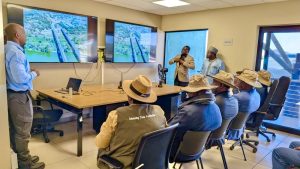 Under the agreement, the countries pledged to harmonise customs procedures, improve digital interoperability, strengthen coordinated risk management systems, enhance information sharing and invest in continuous personnel development to support efficient border operations.
During the benchmarking exercise, the delegation received technical presentations on the Beitbridge Modernisation and Concession Model, covering its financing structure, governance framework, revenue management system and integrated border management architecture.
The customs chiefs also inspected freight terminals, cargo processing centres, scanning facilities, traffic management systems and advanced ICT infrastructure that have transformed Beitbridge into one of Africa’s most efficient commercial border posts.
 Director-General of Cameroon Customs, Fongod Nuvaga, stressed that stronger collaboration among customs administrations remains critical to removing administrative bottlenecks that hinder legitimate trade across Africa.
He noted that coordinated border operations would help African countries fully maximise the opportunities created by the AfCFTA while strengthening customs administration and regional economic integration.

Similarly, Benin Customs Director-General, Colonel Raouf Malèhossou Aboudou, described the Beitbridge model as a practical template for improving border efficiency across West Africa through harmonised procedures, coordinated inspections and institutional cooperation.
Earlier, Afreximbank’s Director for Trade Facilitation and Investment Promotion, Dr. Gainmore Zanamwe, explained that the benchmarking mission was intended to expose participating countries to the governance structures and operational systems that underpin successful modern border posts.
According to him, while infrastructure remains essential, long-term success depends on technology-driven operations, institutional accountability, coordinated governance and measurable service standards.
The One-Stop Border Post concept allows border agencies from neighbouring countries to operate within a single integrated facility where customs, immigration and other regulatory checks are conducted simultaneously. The system is designed to reduce cargo dwell time, cut transport costs, improve revenue collection and enhance security while facilitating the movement of goods and people.
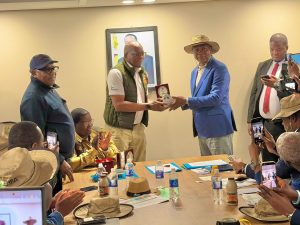 The latest initiative underscores the Nigeria Customs Service’s commitment under Comptroller-General Adewale Adeniyi to expanding regional cooperation, leveraging technology and aligning border management with global best practices. It also supports the Federal Government’s broader agenda of promoting non-oil trade, improving logistics efficiency and positioning Nigeria as a major gateway for intra-African commerce under the AfCFTA.











Nigeria Customs, Benin, Cameroon advance one-stop border initiative after Zimbabwe Mission

Kogi mourns Rear Admiral Hamzat Sani, celebrates legacy of patriotism, statesmanship

‘Victory Is within reach,’ Oyebamiji declares as APC launches Osun Campaign Council
-

 Crime2 years ago
Imo police confirm arrest of journalist, ‘Nonsonkwa’ over alleged Cyberstalking, Incitement
-
 Education5 months ago
Anambra leads South-east in education allocation ratio, as Imo ranks lowest
-
 News6 years ago
Orthodox Anglican Church, not Same as Church of Nigeria- Bishop
-

 Business6 years ago
Pay-As-You-Go not applicable to pay TV – FCCPC
-

 Agriculture4 years ago
Environment Day: Foundation partners, FCMB, Chevron, harps on collective efforts on earth protection
-

 Crime3 years ago
Pastor allegedly kills female member, prevents 20 year old daughter from attending burial