
Business
Otti suspends Abia rail project for wider South-East regional network
By Ezurike Ugochukwu
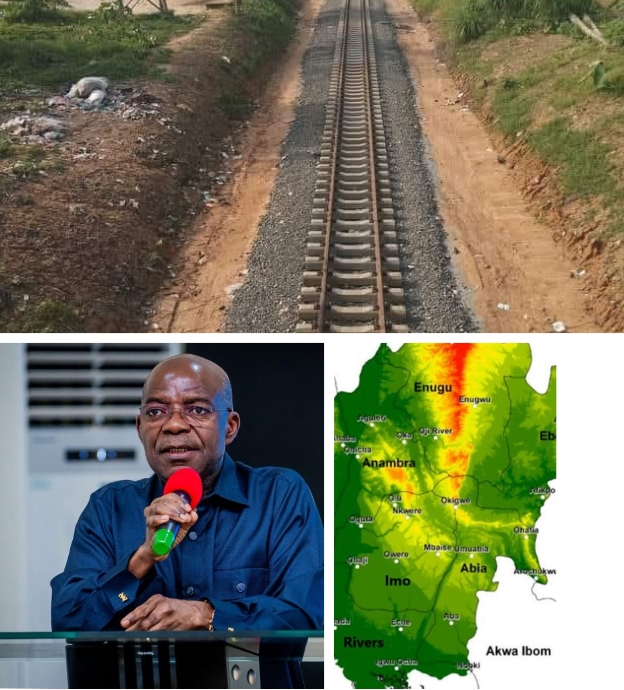
Abia State Governor, Alex Otti, has revealed that South-East states, in collaboration with parts of the South-South, are developing plans for a regional railway network aimed at boosting economic integration, improving connectivity.
The project is said to be addressing what many stakeholders have long described as decades of inadequate federal investment in rail infrastructure across the region.
Speaking during the July edition of his monthly media briefing in Umuahia on Thursday, Otti said the proposed rail network is expected to link Port Harcourt, Aba, Enugu, Imo State and Akwa Ibom, creating an integrated transport corridor to facilitate the movement of people, goods and services.

The governor disclosed that the Abia State Government had initially commissioned a Chinese engineering firm to design a light rail system connecting major parts of the state.
 According to him, the original plan was shelved after consultations showed that a broader regional railway would deliver greater economic benefits than an isolated intra-state project.
“We had engaged a Chinese company which produced a design that would link many parts of the state. But, on further consideration, we found that linking parts of the state without taking neighbouring states into account may not be the best approach,” Otti said.
He explained that discussions are now ongoing among South-East governors and some neighbouring South-South states to develop an interconnected regional rail network capable of supporting commerce, industrialisation and regional development.
“The South-East states and some parts of the South-South are now in discussions on how we can connect ourselves through a regional rail network,” he added.
Otti noted that the existing Port Harcourt–Maiduguri railway already passes through Aba, making it economically sensible to integrate the proposed regional rail project with the Federal Government’s rail infrastructure instead of constructing an entirely separate system.
He said the decision to pursue regional integration accounts for the delay in implementing Abia’s initial light rail proposal.
The governor also announced that his administration has acquired an additional 20 electric buses to improve urban transportation, adding that the vehicles would soon be deployed across the state.
He further disclosed plans to develop new housing estates in Umuahia and Aba, while reaffirming his administration’s commitment to strengthening education, infrastructure, security, science and technology, innovation, arts and culture.
Addressing a Longstanding Infrastructure Deficit
Otti’s regional rail proposal comes against the backdrop of longstanding concerns over what political leaders, economists and regional groups have described as inadequate federal investment in railway infrastructure across the South-East.
Successive administrations have faced criticism for the slow pace of rail development in the region despite its strategic importance as one of Nigeria’s busiest commercial and manufacturing hubs.

Late Buhari
The administration of former President Muhammadu Buhari prioritised several standard-gauge railway projects, including the Abuja-Kaduna, Lagos-Ibadan, Itakpe-Warri, and sections of the Kano-Maradi rail line intended to connect northern Nigeria with Niger Republic.
The Kano-Maradi project, in particular, generated intense public debate, with many South-East leaders questioning the rationale for prioritising a cross-border railway while major economic corridors within the South-East remained without comparable modern rail infrastructure.
Although the Federal Government has revived work on the Port Harcourt-Maiduguri Eastern Narrow Gauge Railway, stakeholders have argued that the project is primarily a rehabilitation of an existing colonial-era line and falls short of the modern standard-gauge rail infrastructure extended to other parts of the country.
Business leaders have repeatedly maintained that an integrated regional railway linking the commercial centres of Aba, Onitsha, Enugu, Owerri, Port Harcourt and neighbouring industrial hubs would significantly reduce logistics costs, improve access to seaports and stimulate manufacturing, agriculture and interstate trade.
Analysts believe that if successfully implemented, the proposed South-East regional railway could complement federal rail infrastructure, strengthen economic integration between the South-East and South-South, and unlock fresh opportunities for investment in one of Nigeria’s most commercially vibrant regions.







Seme–Krake: Nigeria, Benin Customs begin push for seamless border trade
AMJON Conference: NIMASA, Customs, NPA, NSML push innovation, digital skills for future-ready maritime sector

Customs: Discipline, character critical as 2025 recruitment screening enters final phase
-

 Crime2 years ago
Imo police confirm arrest of journalist, ‘Nonsonkwa’ over alleged Cyberstalking, Incitement
-
 Education7 months ago
Anambra leads South-east in education allocation ratio, as Imo ranks lowest
-

 News6 years ago
Orthodox Anglican Church, not Same as Church of Nigeria- Bishop
-

 Business6 years ago
Pay-As-You-Go not applicable to pay TV – FCCPC
-

 Agriculture4 years ago
Environment Day: Foundation partners, FCMB, Chevron, harps on collective efforts on earth protection
-

 Crime3 years ago
Pastor allegedly kills female member, prevents 20 year old daughter from attending burial