
Agriculture
Customs promises to remove bottlenecks hindering onion export trade expansion
By Ezurike Ugochukwu
The Nigeria Customs Service (NCS) has reaffirmed its commitment to supporting onion farmers and export-focused stakeholders by dismantling non-tariff barriers, addressing operational bottlenecks, and strengthening inter-agency collaboration to ensure a seamless export corridor.
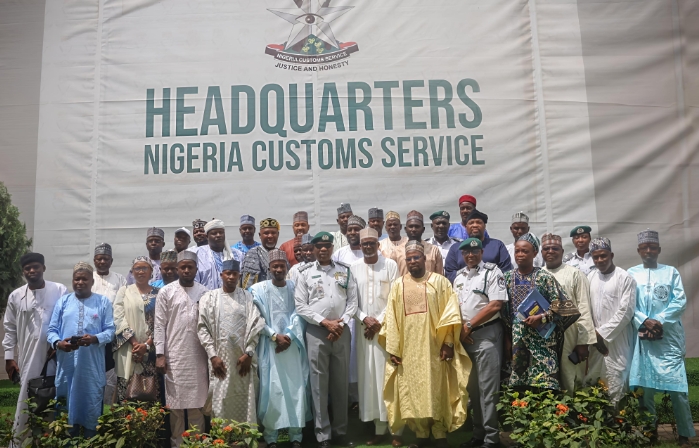
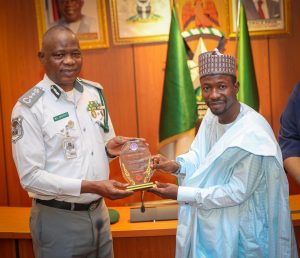
Comptroller-General of Customs, Adewale Adeniyi, gave the assurance last Monday during a courtesy visit by the Regional Observatory of Onion in West and Central Africa (ORO/AOC), led by its President, Aliyu Maitasamu, at the Customs Headquarters in Maitama, Abuja, where both parties discussed measures to enhance export facilitation and corridor management.

CGC Adeniyi
CGC Adeniyi said, “So let me assure onion farmers and other export-oriented stakeholders that the NCS will stand solidly behind you. We will remove all known non-tariff barriers and work with other government agencies and stakeholders to create a more facilitating environment for your trade.”

He explained that the engagement was timely, noting that over the past six months, the Service had faced sustained pressure from economic operators in Benin and the Niger Republic over the use of Nigeria’s transit corridors, particularly routes through northeastern Nigeria and the Kamba axis.

CGC Adeniyi & Maitasamu
According to him, while discussions on transit corridors often focus on imports, the engagement with onion exporters presents an opportunity to strengthen Nigeria’s export narrative and unlock broader economic benefits.
“What you are doing will help us balance the story. We will not only be talking about imports and transit, but also about exports. Exports bring economic prosperity, create employment, support a favourable balance of trade and ultimately contribute to GDP growth,” CGC Adeniyi stated.
He added that, beyond urging compliance, regulatory agencies also have a responsibility to address legitimate stakeholder concerns. He disclosed that, following earlier representations by the association, he directed the Deputy Comptroller-General in charge of Enforcement, Inspection and Investigation to establish a structured engagement framework.
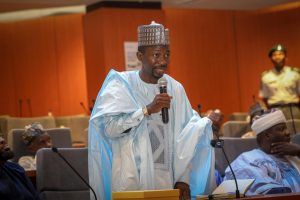 On his part, ORO/AOC President Maitasamu commended the NCS for what he described as a prompt and decisive intervention following recent disruptions along the corridor.
“With recent developments and the reopening now in effect, we are here to appreciate the NCS for its prompt action,” he said, while calling for sustained engagement to ensure smooth and lasting operations, in line with earlier assurances given by the Comptroller-General in Kebbi State.
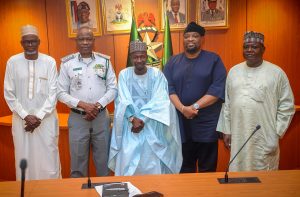
Maitasamu acknowledged the complexity of regulating cross-border trade and affirmed the association’s readiness to work closely with Customs, proposing improved coordination mechanisms for onion transit. He noted that ORO/AOC possesses the infrastructure, expertise and regional presence to support Customs operations, including documentation and compliance management across the corridor.
Highlighting the sector’s economic significance, he disclosed that Nigeria is Africa’s second-largest onion producer after Egypt, with an annual output of about 2.1 million metric tonnes. He added that data from the Food and Agriculture Organisation values Nigeria’s onion production at approximately ₦1.17 trillion, with the Niger Republic and other countries such as Algeria, Sudan, Burkina Faso and Cameroon playing complementary roles in the regional onion value chain.
 He emphasised that Nigeria and the Niger Republic currently remain the two most significant players in onion production and exchange within the ECOWAS and Sahel regions.
Earlier, the Deputy Comptroller-General of Customs in charge of Enforcement, Inspection and Investigation, Timi Bomodi, described the engagement as aligned with government efforts to balance economic growth and security considerations.
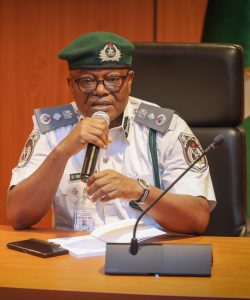
Bomodi
He explained that the proposed token system discussed at the meeting has two core elements —data and infrastructure.
‘’One component is the data, which your association already has. The other is infrastructure. Trucks moving across these corridors put pressure on our roads, and the token system will allow the government to recover some of those costs over time for road maintenance,” DCG Bomodi concluded.










Ogun LG chairman hails Idiroko Customs football initiative, seeks professional pathway for border talents

Nigeria Customs, Benin, Cameroon advance one-stop border initiative after Zimbabwe Mission

Kogi mourns Rear Admiral Hamzat Sani, celebrates legacy of patriotism, statesmanship
-

 Crime2 years ago
Imo police confirm arrest of journalist, ‘Nonsonkwa’ over alleged Cyberstalking, Incitement
-
 Education5 months ago
Anambra leads South-east in education allocation ratio, as Imo ranks lowest
-
 News6 years ago
Orthodox Anglican Church, not Same as Church of Nigeria- Bishop
-

 Business6 years ago
Pay-As-You-Go not applicable to pay TV – FCCPC
-

 Agriculture4 years ago
Environment Day: Foundation partners, FCMB, Chevron, harps on collective efforts on earth protection
-

 Crime3 years ago
Pastor allegedly kills female member, prevents 20 year old daughter from attending burial