
Business
IDSIF 2026: Growing port risks spark reform calls from Jonathan, Bode George
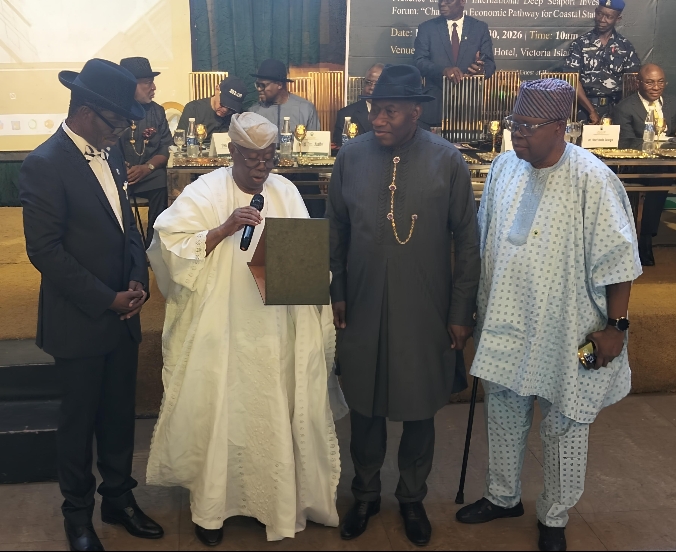
By Ezurike Ugochukwu
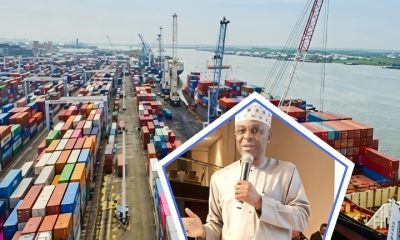
Nigeria’s maritime future came under intense scrutiny on Monday as former President Goodluck Jonathan, elder statesman Chief Bode George, and other industry leaders warned that the country risks losing its cargo traffic to neighbouring ports if urgent steps are not taken to develop deep sea port infrastructure.
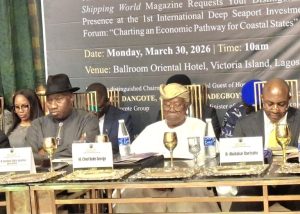
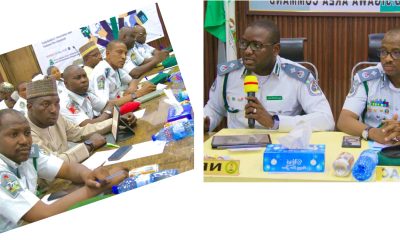
The warning was the central theme at the inaugural International Deep Sea Investment Forum (IDSIF) held at the Oriental Hotel, Lagos, convened by Asu Beks, Chief Executive Officer of Maritime Media Limited.
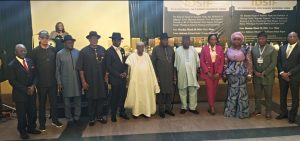 The high-level gathering drew policymakers, port administrators, investors, and maritime stakeholders to examine Nigeria’s port capacity challenges and map out a path toward global competitiveness, warned that over-concentration of port activities, and infrastructure deficits pose significant risks to Nigeria’s economic stability and global maritime competitiveness.

Jonathan while speaking said Nigeria must not be left behind. He set the tone with a stark warning rooted in historical precedent, recalling how Nigeria lost its foothold in global shipping due to poor strategic decisions.
“The world is migrating to another phase, and Nigeria must act quickly. Otherwise, we may wake up one day and no ship will come here again. We will then be forced to transport our goods from neighbouring countries,” he cautioned.
Jonathan cited the collapse of the Nigerian Shipping Line, attributing it partly to the failure to adapt to containerisation, noting:
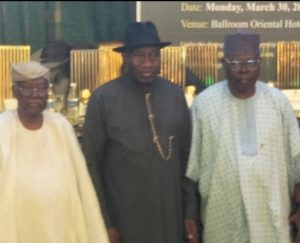
L-R: Chief Bode Geoege, Jonathan and Shittu
“When the world moved to container shipping, we invested in outdated vessels others were discarding. That mistake cost us dearly.”
He urged stakeholders to move beyond discussions to actionable, bankable projects, calling for broader inclusion of coastal states and financial institutions in future engagements.
In his keynote address, convener Asu Beks provided a deeper structural diagnosis, revealing that Nigeria faces an estimated $14 billion deficit in deep seaport infrastructure.
He noted that despite Nigeria’s 853-kilometre coastline and strategic location in West Africa, the country continues to lose cargo traffic to neighbouring ports due to inadequate infrastructure and inefficiencies.
“Out of eight proposed deep seaports, only Lekki is operational today. Investors are concerned about cargo volumes, while local financing remains limited,” he said.
Asu Beks traced Nigeria’s port history from early colonial developments to modern challenges, highlighting how evolving global shipping trends, particularly larger vessels requiring deeper drafts have rendered many existing ports uncompetitive.
He added: “Is Nigeria’s ambition to become a maritime hub fading? That is the critical question we must answer.”
Former Nigerian Ports Authority (NPA) Chairman, Bode George, Bode George who was chairman of the occasion acknowledged Lagos’ natural advantage for port operations but cautioned against relying solely on it, warning that concentrating over 70% of critical infrastructure in one location poses a serious strategic risk,describing it as a strategic vulnerability especially amid global geopolitical uncertainties.
“It is dangerous to concentrate over 70 percent of critical infrastructure in one location. Global tensions—like what we are seeing around the Strait of Hormuz—should serve as a wake-up call,” he said.
He urged President Bola Ahmed Tinubu to make maritime reform part of his legacy by signing the Nigerian Ports and Regulatory Authority Bill.
Other stakeholders were unanimously in Thier call on President Tinubu to sign the Nigerian Shipping and Ports Economic Regulatory Bill, strengthen the Nigerian Shippers’ Council as economic regulator and expand investment beyond Lagos.
“The port rehabilitation loan should not be spent only in Lagos. Development must be spread across other coastal states,” George added.
Speaking from the standpoint of ‘Green Ports and Connectivity’, Minister of Marine and Blue Economy, Adegboyega Oyetola, represented by the NPA’s General Manager of Corporate and Strategic Planning, Mr Seyi Iyawe, outlined the Federal Government’s commitment to modernising port infrastructure.
The government emphasised a green port agenda, automation, and improved hinterland connectivity as critical pillars.
“Deep seaports are important, but connectivity is key. Cargo must move efficiently. With the National Single Window now in place, we must build smart, automated ports,” a representative stated.
Airing a divergent view, former NPA Managing Director Bello Gwandu cautioned against over-investment without adequate cargo flow.
“There is nothing worse than building a port that is not patronised. Nigeria needs efficient international ports, not just deep seaports,” he argued.
However, others, including former NDDC Managing Director Timi Alaibe, stressed the importance of sustained investment.
“We must move from planning to action. The Gulf of Guinea remains critical for investor confidence,” Alaibe said.
The forum also served as a platform for subnational advocacy, with Bayelsa State promoting the Agge Deep Seaport project.
Commissioner for Marine and Blue Economy, Faith Zibs, highlighted its strategic advantages:
“With vast waterways and proximity to international routes, Agge can serve Nigeria and the sub-region. Deep seaports are catalysts for industrialisation.”
Other speakers at the event pointed to broader systemic issues, structural challenges and global context. They further emphasized Poor cargo evacuation systems, limited rail /road connectivity, high cost of doing business at ports and regulatory inefficiencies.
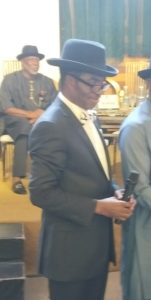
Asu Beks
Asu Beks had earlier raised geopolitical concerns, questioning the risks of concentrating maritime assets amid global tensions.
“Is it economically and politically wise to cluster critical infrastructure in one region?” he asked.
He summed up the industry’s expectation by saying: “When you give me a vehicle, you must also release the key. The sector needs empowerment to function effectively.”
He also commended the creation of the Marine and Blue Economy Ministry and the introduction of the National Single Window system.
 The forum underscored a defining moment for Nigeria’s maritime sector With only one operational deep seaport and billions of dollars in infrastructure gaps, stakeholders warn that failure to act could erode Nigeria’s regional dominance, shift trade flows to neighbouring countries and undermine economic growth ambitions.










-

 Crime2 years ago
Imo police confirm arrest of journalist, ‘Nonsonkwa’ over alleged Cyberstalking, Incitement
-

 News6 years ago
Orthodox Anglican Church, not Same as Church of Nigeria- Bishop
-

 Business6 years ago
Pay-As-You-Go not applicable to pay TV – FCCPC
-

 Crime3 years ago
Pastor allegedly kills female member, prevents 20 year old daughter from attending burial
-

 Agriculture4 years ago
Environment Day: Foundation partners, FCMB, Chevron, harps on collective efforts on earth protection
-
 News2 years ago
Ex-TCN Abuja GM, Nwaire wears cap of General Overseer Christian Life Gospel Assembly