
Law
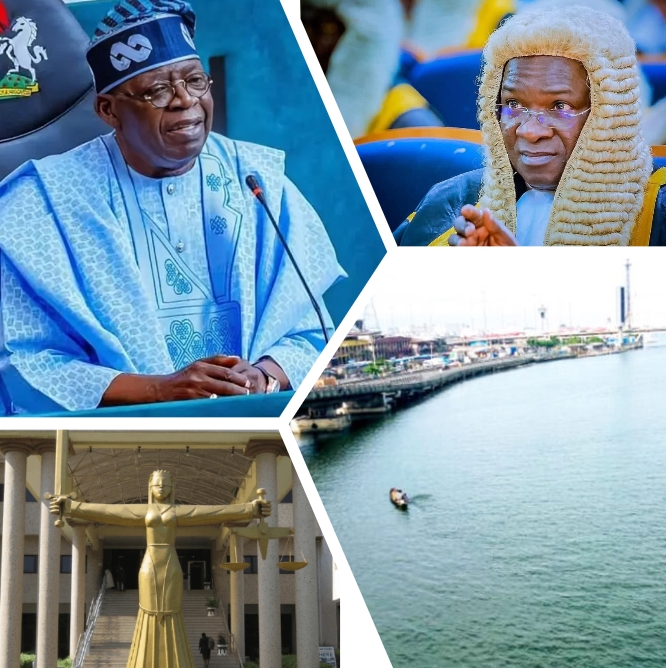
Fashola leads Lagos to landmark victory against FG in waterway control dispute
…Reinforces state powers over waterfront lands
By Ezurike Ugochukwu
The Supreme Court judgment nullifying portions of the National Inland Waterways Authority (NIWA) Act is being viewed as a major constitutional and economic victory for Lagos State, potentially expanding the state government’s authority over waterfront development, land administration and revenue generation along its extensive coastal corridors.
The legal battle, led by former Lagos State governor and Senior Advocate of Nigeria, Babatunde Raji Fashola, alongside senior lawyers Olasupo Shasore and Muiz Banire, challenged what Lagos described as federal encroachment on lands adjoining inland waterways within the state.

 In its ruling, the Supreme Court held that Sections 12 and 13 of the NIWA Act were unconstitutional to the extent that they granted the Federal Government powers over lands bordering waterways for purposes outside navigation, maritime transport and fishing activities.
 For Lagos, the verdict could significantly alter control over some of the country’s most commercially valuable waterfront zones stretching across Lekki, Ikoyi, Victoria Island, Badagry, Ibeju-Lekki and other coastal communities where disputes between federal agencies and the state government have persisted for years.
The judgment is expected to strengthen Lagos State’s position in regulating urban planning, issuing development permits, collecting land-based revenues and controlling physical development around waterfront areas previously subjected to overlapping federal and state claims.
Analysts say the ruling may also affect future infrastructure projects, tourism developments, shoreline real estate investments and environmental management policies around Lagos waterways.
 The case itself reflects a long-standing constitutional struggle between Lagos State and federal authorities over jurisdictional boundaries tied to Nigeria’s inland waterways framework.
Successive Lagos administrations had argued that NIWA expanded its powers beyond navigation and maritime safety into areas constitutionally reserved for state governments, particularly land administration under the Land Use Act.
By leading the legal challenge, Fashola himself a former Minister of Works and Housing under the Federal Government brought both constitutional and administrative experience to the dispute, reinforcing Lagos’ arguement that federal agencies cannot assume blanket authority over adjoining lands simply because they are near waterways.
Although the judgment preserves federal powers over navigable waterways and maritime operations, it narrows NIWA’s regulatory reach and could trigger broader reviews of federal-state relations in Nigeria’s maritime, environmental and urban development sectors.
 Legal experts believe the verdict may encourage other coastal and riverine states to re-examine federal control over waterfront assets and related economic activities within their territories.







Ododo seeks Apostolic Church’s prayers for Kogi’s peace, prosperity

Gov Ododo approves reconstruction of 50-year-old Amuro Community Secondary School

31 years of waiting: MWUN seeks payment of NNSL Seafarers’ entitlements before it’s too late
-

 Crime2 years ago
Imo police confirm arrest of journalist, ‘Nonsonkwa’ over alleged Cyberstalking, Incitement
-

 Education7 months ago
Anambra leads South-east in education allocation ratio, as Imo ranks lowest
-
 News6 years ago
Orthodox Anglican Church, not Same as Church of Nigeria- Bishop
-

 Business6 years ago
Pay-As-You-Go not applicable to pay TV – FCCPC
-

 Agriculture4 years ago
Environment Day: Foundation partners, FCMB, Chevron, harps on collective efforts on earth protection
-

 Crime3 years ago
Pastor allegedly kills female member, prevents 20 year old daughter from attending burial