
Law
Supreme Court narrows NIWA authority to navigation, maritime activities
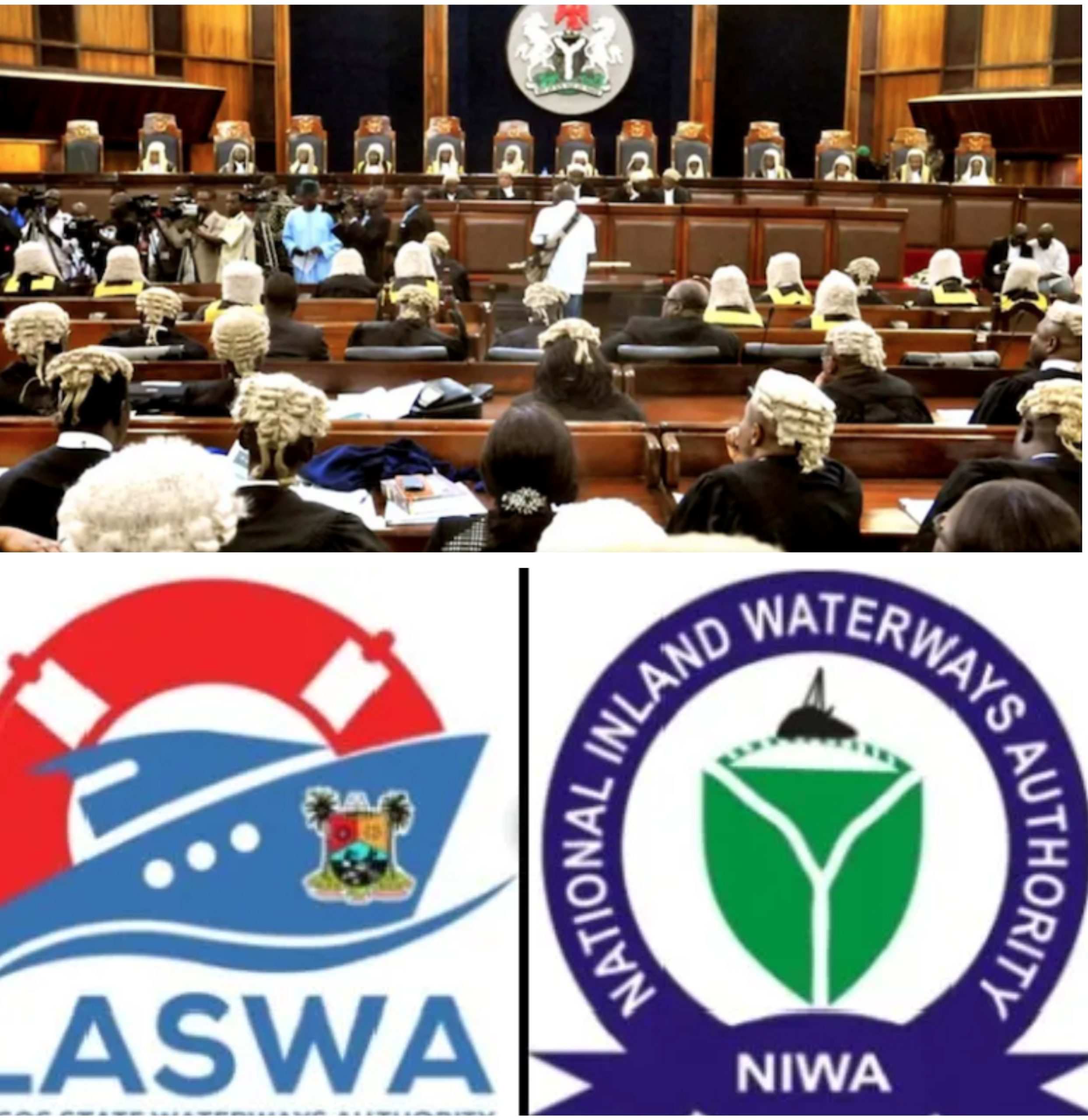
…Declares FG’s expansion into waterway lands unconstitutional
By Ezurike Ugochukwu
The Supreme Court has delivered a landmark judgment restricting the Federal Government’s powers over lands adjoining Nigeria’s inland waterways, ruling that parts of the National Inland Waterways Authority (NIWA) Act are unconstitutional.
In a decision expected to reshape the legal and administrative control of waterfront developments across the country, the apex court held that the Federal Government cannot exercise authority over lands bordering waterways for purposes unrelated to navigation, maritime operations or fishing activities.

The judgment was delivered Thursday 21, May 2026 in a suit filed by Lagos State against the Federal Government challenging the constitutional validity of Sections 12 and 13 of the NIWA Act.
A seven-member panel of the Supreme Court led by Justice Mohammed Lawal Garba ruled that the disputed provisions exceeded the legislative powers granted to the National Assembly under the 1999 Constitution.
Justice Abubakar Sadiq Umar, who read the lead judgment, held that while the Federal Government retains authority over navigable waterways and matters directly connected to maritime transportation, it cannot extend such powers to adjoining lands for broader developmental or regulatory purposes outside navigation.
According to the court, the National Assembly acted ultra vires by empowering NIWA to regulate and control lands bordering waterways beyond constitutionally permitted maritime functions.
The ruling effectively limits federal oversight to activities strictly connected with inland navigation, shipping, maritime safety and fishing operations, while reinforcing the constitutional powers of states over land administration within their territories.
The decision followed objections by the Federal Government challenging the jurisdiction of the Supreme Court to entertain the suit, objections which were dismissed before the court proceeded to determine the substantive issues.
Senior Advocates of Nigeria, including Babatunde Raji Fashola, Olasupo Shasore and Muiz Banire, represented Lagos State, while Akin Olujimi appeared for the Federal Government.
Legal analysts say the judgment could have significant implications for waterfront development, urban planning, environmental regulation and revenue administration in coastal and riverine states, especially Lagos where disputes over shoreline control and waterfront projects have persisted for years.
The verdict may also trigger fresh reviews of federal regulatory powers over inland waterways and land use administration across Nigeria’s maritime and riverine corridors.











-

 Crime2 years ago
Imo police confirm arrest of journalist, ‘Nonsonkwa’ over alleged Cyberstalking, Incitement
-

 Education7 months ago
Anambra leads South-east in education allocation ratio, as Imo ranks lowest
-
 News6 years ago
Orthodox Anglican Church, not Same as Church of Nigeria- Bishop
-

 Business6 years ago
Pay-As-You-Go not applicable to pay TV – FCCPC
-

 Agriculture4 years ago
Environment Day: Foundation partners, FCMB, Chevron, harps on collective efforts on earth protection
-

 Crime3 years ago
Pastor allegedly kills female member, prevents 20 year old daughter from attending burial