
Crime
Apapa Customs busts dangerous cargo, seizes 7.6 tonnes cannabis, 170,000 codeine bottles

By Ezurike Ugochukwu
The Nigeria Customs Service (NCS), Apapa Area Command, has intercepted a major consignment of prohibited and security-sensitive goods, including more than 7.6 tonnes of cannabis, 169,998 bottles of codeine syrup and 108 drones, in a series of intelligence-led operations.
The seizures, which also included expired pharmaceutical and consumer products as well as 1,282 bales of used clothing, had a combined Duty Paid Value (DPV) of ₦43.59 billion, according to the Comptroller-General of Customs, Bashir Adewale Adeniyi.
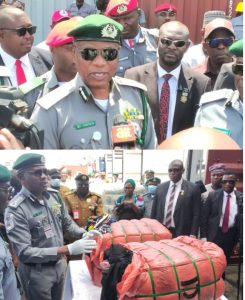
Adeniyi, who disclosed the seizures while briefing journalists on Thursday, said criminal syndicates were increasingly concealing dangerous goods within legitimate consignments as they sought to evade detection by Customs and other security agencies.

He said the development had made intelligence-led cargo profiling, risk assessment and targeted examination increasingly critical to preventing narcotics, controlled pharmaceuticals, security-sensitive equipment and unsafe products from reaching the Nigerian market.
“Narcotics are packed among vehicle spare parts and used vehicles. Controlled drugs travel beneath household goods. Restricted equipment is declared as ordinary electronics,” Adeniyi said.
The CG, however, clarified that the ₦43.59 billion figure represented the combined Duty Paid Value of the seized consignments, reflecting applicable customs duties and taxes used in assessing the cargoes, rather than the street or commercial value of the prohibited items.
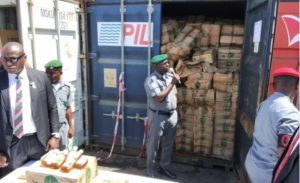
7.6 Tonnes of Cannabis: Giving details of the seizures, Adeniyi said three 40-foot containers contained 15,245 parcels of cannabis sativa weighing 7,624kg, or more than 7.6 tonnes.
One of the containers held 4,777 parcels weighing 2,388.5kg, concealed alongside automobile spare parts, coffee mix, oats and three vehicles.
Another contained 8,287 parcels weighing 4,145kg, while the third held 2,181 parcels weighing 1,090.5kg, concealed alongside foreign rice, automobile spare parts, lithium batteries and other goods.
According to Adeniyi, the cannabis seizures resulted from intelligence-led operations conducted in collaboration with the National Drug Law Enforcement Agency (NDLEA) and international security partners.
He said the operations involved documentary scrutiny, cargo profiling and targeted examination designed to identify consignments presenting elevated risks.

170,000 Bottles of Codeine: Another major interception involved a 40-foot container containing 1,700 cartons of codeine syrup, totalling 169,998 bottles.
The controlled pharmaceutical product was concealed beneath household items, according to the CG.
The discovery, he said, further demonstrated the increasingly sophisticated methods being employed by criminal networks to disguise prohibited goods as legitimate imports.
Adeniyi said the Service had responded by strengthening cargo profiling and risk assessment across its commands, supported by technology and intelligence-sharing arrangements.
He cited the B’Odogwu platform and the INTERPOL Data Centre established at the Customs headquarters in Abuja as important components of the Service’s evolving intelligence and risk-management architecture.
The Customs Service has also deepened collaboration with the NDLEA, the National Agency for Food and Drug Administration and Control (NAFDAC), the Office of the National Security Adviser (NSA) and international security partners.
108 Drones Sized: The operation also led to the interception of 108 drones.
Adeniyi acknowledged that drones have legitimate civilian and commercial applications but warned that the technology could become a security threat when acquired or deployed by criminal elements for surveillance, reconnaissance or other illicit activities.
He disclosed that the seized drones would be handed over to the Office of the National Security Adviser for further investigation.
The seizure comes amid growing concerns over the potential use of commercially available unmanned aerial systems for criminal surveillance and other security-sensitive activities.
Expired Drugs, Consumer Products Intercepted: Customs also intercepted five containers loaded with expired tomato ketchup, antiseptic liquid, vaginal tablets and disposable nappies.
Adeniyi said the expired products posed serious risks to consumers if allowed into circulation, particularly children and women who could be exposed to unsafe products.
He disclosed that the seized drugs and pharmaceutical products would be handed over to the NDLEA and NAFDAC for further investigation and appropriate regulatory action.
The operation further yielded 1,282 bales of used clothing from three containers.
Customs Assures Compliant Importers: Despite the scale of the seizures, Adeniyi assured legitimate importers that the enforcement operations were not intended to frustrate lawful trade.
He said Customs would continue to facilitate compliant cargo while intensifying efforts against concealment, false declaration, undervaluation and the importation of prohibited and security-sensitive goods.
The CG urged importers who were uncertain about the classification, valuation or origin of their goods to make use of the Service’s Advance Ruling mechanism before shipment.
He also encouraged compliant operators to enrol in the Authorised Economic Operator programme, which provides benefits to businesses that demonstrate sustained compliance with customs requirements.
“Compliance is not an obstacle to business; it is an advantage over competitors who lack it,” Adeniyi said.

He warned that no port, border station or logistics channel would be allowed to become a safe haven for prohibited goods, false declaration, concealment or undervaluation.
The latest seizures, he said, underscored the need for Customs to combine technology, intelligence, inter-agency cooperation and targeted enforcement to protect national security, public health and legitimate trade.
For the Apapa Command, the challenge now extends beyond intercepting individual consignments to disrupting the networks attempting to exploit Nigeria’s legitimate trade channels to move narcotics, controlled medicines and other dangerous goods into the country.












Seme–Krake: Nigeria, Benin Customs begin push for seamless border trade
AMJON Conference: NIMASA, Customs, NPA, NSML push innovation, digital skills for future-ready maritime sector

Customs: Discipline, character critical as 2025 recruitment screening enters final phase
-

 Crime2 years ago
Imo police confirm arrest of journalist, ‘Nonsonkwa’ over alleged Cyberstalking, Incitement
-

 Education6 months ago
Anambra leads South-east in education allocation ratio, as Imo ranks lowest
-

 News6 years ago
Orthodox Anglican Church, not Same as Church of Nigeria- Bishop
-

 Business6 years ago
Pay-As-You-Go not applicable to pay TV – FCCPC
-

 Agriculture4 years ago
Environment Day: Foundation partners, FCMB, Chevron, harps on collective efforts on earth protection
-

 Crime3 years ago
Pastor allegedly kills female member, prevents 20 year old daughter from attending burial