
News
Ecology funds flow, flood risks remain: Lagos canals still overrun by weeds, waste

By Ezurike Ugochukwu
Despite receiving about ₦2.7 billion in ecological intervention funds within the first five months of 2026, Lagos State and its 20 constitutionally recognised local government areas are still battling clogged canals, raising fresh concerns over flood preparedness and the utilisation of environmental intervention funds.
 Every heavy rainfall in Lagos exposes the same troubling reality – overflowing canals, blocked drains and flooded neighbourhoods. But behind the annual flood misery lies a question demanding answers: What impact has the ₦2.7 billion in ecology funds received by Lagos State and its local governments this year made on flood control?
An investigation based on disbursement data from the National Bureau of Statistics (NBS) and the Office of the Accountant-General of the Federation (OAGF) showed that between January and May 2026, the Lagos State Government received ₦1.493 billion, while the state’s 20 local governments shared an additional ₦1.199 billion from the Federal Government’s Ecological Fund.

 The Ecological Fund, established in 1981, is intended to finance emergency interventions against environmental challenges such as flooding, erosion, drought, desertification and oil spills.
However, visits to several drainage channels and secondary canals across Surulere, Ajeromi-Ifelodun and Amuwo-Odofin revealed waterways heavily clogged with water hyacinth, overgrown weeds, plastic waste and other refuse capable of restricting water flow ahead of the peak rainy season.
Environmental experts warn that such blockages significantly reduce the capacity of drainage systems to evacuate stormwater, increasing the likelihood of flooding in densely populated communities.
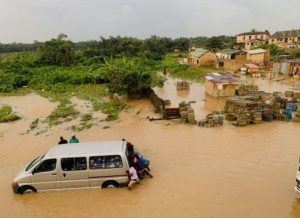 Studies cited by scholars indicate that invasive aquatic weeds such as water hyacinth can reduce water flow in canals by between 40 and 95 per cent, creating physical barriers that trap refuse, increase sediment build-up and impede drainage.
According to the disbursement records, Lagos State Government received ₦251.46 million in January, ₦230.6 million in February, ₦296 million in March, ₦371 million in April and ₦344 million in May, bringing its total ecology allocation during the period to ₦1.493 billion.
Similarly, the 20 local governments collectively received ₦202.9 million in January, ₦180 million in February, ₦238.9 million in March, ₦299.57 million in April and ₦277.67 million in May, amounting to ₦1.199 billion.
Among the councils, Alimosho received the highest allocations throughout the five-month period, while councils including Ajeromi-Ifelodun, Surulere, Amuwo-Odofin, Ojo, Kosofe, Ikorodu and Oshodi-Isolo also received substantial ecological funds.
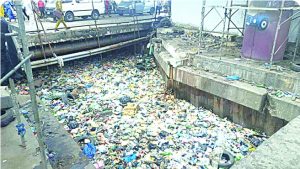 Ironically, some of the canals inspected within these councils showed little evidence of sustained desilting or vegetation clearance, with several drainage channels almost completely covered by aquatic weeds and floating refuse.
 The findings come as the Nigerian Meteorological Agency (NiMet) and the Lagos State Government have repeatedly warned residents of above-normal rainfall and possible flooding in vulnerable communities during the 2026 rainy season.
Environmental stakeholders say while ecology funds are not exclusively meant for clearing canals, regular drainage maintenance remains one of the most visible and effective flood mitigation measures expected from both state and local authorities.
They argue that failure to keep drainage channels free of weeds, silt and refuse not only undermines public investments in flood control but also increases the risk of property damage, traffic disruption and public health emergencies during heavy rainfall.
The situation is likely to renew public calls for greater transparency and accountability in the utilisation of ecological intervention funds, with residents and civil society groups urging state and local governments to publish details of projects executed with the allocations and intensify maintenance of drainage infrastructure before flooding worsens.
 With billions of naira already disbursed under the Ecological Fund this year, many Lagos residents say the true measure of success should not lie in the amount released, but in cleaner waterways, free-flowing canals and a tangible reduction in the perennial flooding that continues to affect communities across the state.







-

 Crime2 years ago
Imo police confirm arrest of journalist, ‘Nonsonkwa’ over alleged Cyberstalking, Incitement
-
 Education7 months ago
Anambra leads South-east in education allocation ratio, as Imo ranks lowest
-
 News6 years ago
Orthodox Anglican Church, not Same as Church of Nigeria- Bishop
-

 Business6 years ago
Pay-As-You-Go not applicable to pay TV – FCCPC
-

 Agriculture4 years ago
Environment Day: Foundation partners, FCMB, Chevron, harps on collective efforts on earth protection
-

 Crime3 years ago
Pastor allegedly kills female member, prevents 20 year old daughter from attending burial