
Business
Tradition meets enforcement: Afeni’s Ipokia homecoming resonates fresh push in war against smuggling

“Without community buy-in, enforcement becomes not only difficult but deadly”
By Ezurike Ugochukwu
In Nigeria’s long and complex battle against smuggling, the most decisive victories are often not won at checkpoints or border posts, but in palaces, town halls and community squares where trust is built, alliances are forged and local legitimacy is secured.
This truth came into sharp focus on February 3, 2026, when the Acting Customs Area Controller of Ogun I Command, Comptroller Oladapo Afeni, paid a symbolic yet strategic courtesy visit to the palace of the Onipokia of Ipokia Kingdom, Dr. Yisa Sola Adeniyi Olaniyan tagged, a ‘home coming’.
More than a routine official engagement, the visit underscored a deeper recalibration in border governance: one that places traditional institutions at the heart of national security, economic protection and community-driven enforcement.

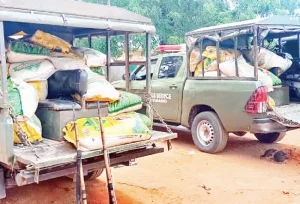
Descriptive photograph
For Ipokia, a border kingdom indeed whose name is inseparable from Nigeria’s age-old struggle with illicit cross-border trade, the moment marked both a reckoning with the past and a recommitment to a more secure future.
Ipokia and it’s big impact
Ipokia Local Government Area sits along Nigeria’s porous southwestern border with the Republic of Benin, a geography that has shaped its history, economy and security realities. For decades, the border communities of Ogun State as: Ipokia, Idiroko, Ilara, Owode and their environs have been flashpoints in the national anti-smuggling narrative.

Typical hardship faced by border communities over closure of filling stations
From rice and poultry products to textiles, petroleum products and, more recently, arms and ammunition, the routes crisscrossing Ipokia have been exploited by smuggling syndicates seeking to undermine Nigeria’s trade policies and economic stability. Past seizures by the Nigeria Customs Service (NCS) in Ogun I Command have often told grim stories: trucks laden with contraband rice intercepted after midnight chases; warehouses uncovered deep within border towns; and, tragically, violent confrontations that claimed lives on both sides of the law.
These realities have made Ogun’s border communities both strategic partners and unavoidable stakeholders in the country’s economic security architecture. It is against this backdrop that Comptroller Afeni’s visit resonated far beyond ceremonial courtesies.
A Homecoming with Strategic Undertones

According to a press release issued by the Command’s Public Relations Officer, Chado Zakari, the Acting Controller’s visit to the Onipokia was part of deliberate efforts to strengthen collaboration between the Nigeria Customs Service and host communities. But for many in Ipokia, it was also a homecoming.
Comptroller Afeni described Ipokia as “home,” a choice of words that carried weight in a region where trust in federal institutions has often been tested by years of economic hardship, enforcement tensions as closing up shops in marketplace in the guise of seizing smuggled rice and the unintended consequences of border closures.
Addressing the traditional council, Afeni expressed gratitude for the warm reception and commended the monarchs for their role in sustaining peace and stability within the kingdom.

He emphasised that effective border management cannot be achieved through enforcement alone, but through cooperation with traditional rulers who understand the social fabric, informal networks and local dynamics of their communities.
This approach he noted, “aligns with the policy direction of the Comptroller-General of Customs Dr. Bashir Adewale Adeniyi, which prioritises synergy, intelligence-sharing and community engagement as pillars of modern customs administration.”
Due recognition
Perhaps the most striking aspect of Afeni’s engagement was his explicit recognition of traditional rulers as critical partners in the anti-smuggling war. In a country where policy power drunkenness often overlooks indigenous governance systems, the acknowledgment was both refreshing and strategic.

Afeni reminded the council that smuggling is not a victimless crime. Beyond revenue losses, illicit trade fuels insecurity, distorts local economies and exposes communities to violence. Ogun State, in particular, has witnessed how smuggling syndicates exploit unemployment and poverty, recruiting young men into dangerous criminal networks with its adverse consequences.
Even as recent cases fester, past incidents bear testimony. In 2019, intensified anti-smuggling operations around Idiroko and Ipokia led to multiple seizures of foreign parboiled rice, triggering violent resistance from smugglers. In 2021 and 2023, Customs officers came under coordinated attacks in parts of Ogun, incidents the Service linked directly to renewed enforcement pressure. These clashes exposed a painful reality: without community buy-in, enforcement will continue to be a herculean task and at most times deadly.

Typical smuggling activities
Afeni urged traditional leaders to continue sensitising residents, especially youths, on the dangers of smuggling and its long-term consequences. He stressed that national security is inseparable from local responsibility, and that border communities must see themselves not as victims of policy but as guardians of national interest.
CGC Adeniyi’s CSR/ inclusivity as a Tool of Engagement

In a significant departure from the enforcement-only narrative often associated with Customs operations, the Acting Controller also highlighted the Corporate Social Responsibility (CSR) initiatives introduced under the leadership of the Comptroller-General of Customs, CGC Adewale Adeniyi.
These initiatives, he explained, are designed to address one of the root causes of smuggling: economic exclusion. By supporting community development, education and social welfare, the Service hopes to reduce the allure of illicit trade and foster a sense of shared ownership of border security.
For communities like Ipokia, where generations have grown up straddling formal and informal economies, such programmes represent a critical bridge between policy intent and lived realities.
Royal synergy/ Endorsement of Afeni
In his response, the Onipokia of Ipokia Kingdom, Oba Yisa Sola Adeniyi Olaniyan, did not mince words. He commended the Comptroller-General of Customs for what he described as “transformative leadership” and a clear commitment to global best practices which has brought him to global embrace.

Welcoming Afeni as a “son of the soil,” the monarch pledged the full support and cooperation of the Ipokia Kingdom to the Nigeria Customs Service. The endorsement was not merely rhetorical; in traditional settings, royal backing often translates into tangible influence over community attitudes and behaviours.
The Onipokia encouraged the Acting Controller to discharge his duties without fear or favour, reaffirming Ipokia’s identity as a peaceful and law-abiding community committed to supporting the Federal Government’s economic objectives.

His words carried a subtle but powerful message: that the era of adversarial relationships between border communities and enforcement agencies must give way to partnership and mutual accountability.
Promises for the Future
The significance of the Ipokia engagement becomes clearer when viewed through the lens of history. Previous administrations have learned, sometimes painfully, that border security cannot be sustained by force alone. The 2019 land border closure, while successful in boosting local rice production and customs revenue, also strained relations with border communities who felt economically suffocated.

Descriptive photograph
In the aftermath, Customs commands across the country began rethinking their engagement strategies, placing greater emphasis on dialogue, intelligence-led operations and community relations. Comptroller Afeni’s visit appears to be a continuation -and perhaps a deepening -of that shift.
By anchoring enforcement within traditional legitimacy, the Nigeria Customs Service stands a better chance of dismantling smuggling networks that rely on local complicity and silence.
A New Chapter at the Border
Clearly at the end of the meeting, what lingered was not just the symbolism of an official visit, but the sense of a renewed social contract. In a kingdom long defined by its proximity to the border, Ipokia is being invited to redefine itself as a frontline partner in national development rather than a corridor of contraband.

For Comptroler Afeni, the visit reinforced a leadership philosophy grounded in respect, inclusion and strategic collaboration. For the Onipokia and his council, it was an opportunity to assert traditional authority in service of national interest. And for Nigeria, it was a reminder that the fight against smuggling will only be won when communities are not merely policed, but engaged, empowered and trusted.





-

 Crime2 years ago
Imo police confirm arrest of journalist, ‘Nonsonkwa’ over alleged Cyberstalking, Incitement
-
 Education7 months ago
Anambra leads South-east in education allocation ratio, as Imo ranks lowest
-
 News6 years ago
Orthodox Anglican Church, not Same as Church of Nigeria- Bishop
-

 Business6 years ago
Pay-As-You-Go not applicable to pay TV – FCCPC
-

 Agriculture4 years ago
Environment Day: Foundation partners, FCMB, Chevron, harps on collective efforts on earth protection
-

 Crime3 years ago
Pastor allegedly kills female member, prevents 20 year old daughter from attending burial