By Ezurike Ugochukwu
The Governing Board of the Nigerian Shippers’ Council (NSC) has pledged its full support for the Council’s management in advancing key reforms aimed at helping the Federal Government achieve a minimum economic growth rate of seven per cent by 2027–2028 and realise President Bola Tinubu’s vision of a one-trillion-dollar economy by 2030.
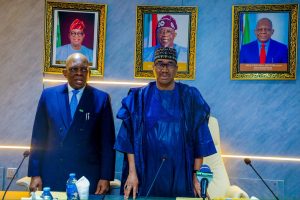
Akutah and Shema
The Board Chairman, Dr Ibrahim Shema, made this commitment in Lagos on Thursday during the inaugural meeting of the newly inaugurated board, stressing that close collaboration between the board and management would be critical to attaining the ambitious national economic targets.
Dr Shema, a former Governor of Katsina State, noted that the scale of the task ahead would require sustained commitment, discipline and strategic focus from all stakeholders within the Council.
According to him, both the Nigerian Shippers’ Council and the Ministry of Marine and Blue Economy are fully aligned with the President’s economic agenda, particularly the drive to unlock the vast potential of the maritime and blue economy sectors.
 “The Council, the Board and management are hereby called to service. We have a lot of work ahead of us,” Shema said, adding that all hands must be on deck for Nigeria to fully harness the opportunities within the blue economy.
He explained that the board would prioritise initiatives capable of strengthening the maritime sector’s contribution to national and international trade, including improving the ease of doing business at the ports, facilitating trade and commerce, boosting revenue generation and deepening collaboration with stakeholders across the real economy and the maritime industry.
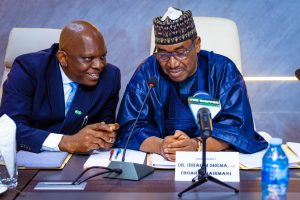
Akutah and Shema
Earlier, the Executive Secretary and Chief Executive Officer of the Council, Dr Pius Akutah, underscored the importance of a strong and cooperative relationship between the board and management, describing it as essential for delivering tangible institutional and financial outcomes for the NSC.
Dr Akutah identified several priority reforms requiring the board’s guidance and support, including the actualisation of the Nigeria Port Economic Regulatory Agency (NPERA) Bill, the implementation of the International Cargo Tracking Note (ICTN), and the operationalisation of the one per cent Freight Stabilisation Fee.
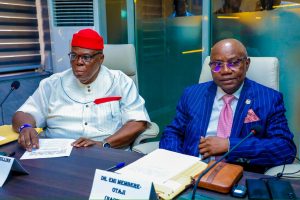 “These initiatives are critical to strengthening regulatory clarity, improving cargo visibility, enhancing national security, and securing sustainable revenue for the Council,” he said.
He added that while the responsibilities before the Council were considerable, they also presented a major opportunity to reposition the NSC as a financially resilient and institutionally stronger regulator within Nigeria’s maritime ecosystem.
“Management is fully committed to supporting the Board with robust data, sound financial analysis and structured stakeholder engagement to ensure that all initiatives are pursued in a lawful, transparent and stakeholder-responsive manner,” Akutah stated.
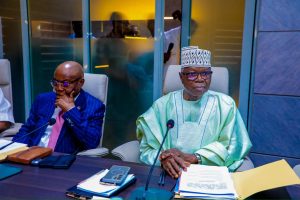 He further expressed confidence that with the guidance of the new board, the Council would continue to protect shippers’ interests, promote efficient port operations and make meaningful contributions to national economic growth.
Describing the inaugural meeting as a landmark moment in the history of the Council, the Executive Secretary said the quality and composition of the board provided strong assurance that the NSC’s strategic objectives would be effectively achieved.

















 Crime2 years ago
 News6 years ago
 Business6 years ago
 Crime3 years ago
 News2 years ago
 News6 years ago