
Business
Renewed Hope at Nigeria’s Ports: Billions saved,trade boosted, regulations strengthened under Akutah

By Ezurike Ugochukwu
When Dr. Pius Akutah assumed office as Executive Secretary and Chief Executive Officer of the Nigerian Shippers’ Council (NSC) in November 2023, he inherited an institution long regarded as the protector of shippers’ interests but constrained by limited statutory powers, inadequate funding and a rapidly evolving maritime industry.
Nearly three years later, the council has emerged as one of the most active reform-driven agencies in Nigeria’s maritime sector, recording significant milestones in trade facilitation, regulatory oversight, digital transformation and institutional development.

The achievements, according to Dr. Akutah, are products of deliberate reforms anchored on the Renewed Hope Agenda of President Bola Ahmed Tinubu and the policy direction of the Minister of Marine and Blue Economy, Adegboyega Oyetola.

Speaking during an interactive session with maritime editors and reporters in Lagos, Akutah presented what amounts to a comprehensive scorecard of a reform agenda designed to make Nigerian ports more efficient, transparent and globally competitive.
Protecting Billions for Shippers and the Economy
 Perhaps the most striking achievement under the current leadership is the economic value preserved through regulatory interventions and Alternative Dispute Resolution (ADR).
Between the fourth quarter of 2023 and the second quarter of 2026, the Council safeguarded more than ₦90.60 billion and US$1.348 million for Nigerian importers, exporters and the wider economy.

Mrs Rebecca Adamu, Head, Public Relations, NSC
The bulk of these savings came from preventing the payment of ₦86.06 billion in unjustified demurrage charges, while additional recoveries running into billions of naira and over one million dollars were secured through the settlement of commercial disputes involving terminal operators, shipping companies and port users.
Beyond the impressive figures lies an even more significant outcome, the restoration of confidence among port users that disputes can now be resolved fairly without prolonged litigation.
 During the review period, the Council received 558 complaints and successfully resolved 295 commercial disputes, covering demurrage, detention, cargo claims, export fraud and terminal charges.
Towards an Independent Port Economic Regulator
One of the defining milestones of Akutah’s administration is the successful passage of the Nigerian Port Economic Regulatory Agency (NPERA) Bill by both chambers of the National Assembly.
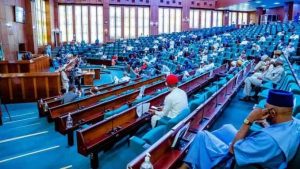 Once signed into law by the President, the legislation will transform the NSC into an independent Port Economic Regulator with clearer legal authority to regulate tariffs, monitor service standards, discourage anti-competitive practices and strengthen investor confidence within the maritime sector.
For stakeholders, the proposed law represents the missing institutional framework that has long been required to ensure predictability, fairness and accountability in Nigeria’s port system.
Historic Funding Breakthrough
For the first time since its establishment in 1978, the Council has secured statutory funding through the 2025 Appropriation Act.
The development addresses one of the institution’s longest-standing challenges and provides the financial stability required to effectively discharge its expanding regulatory responsibilities.
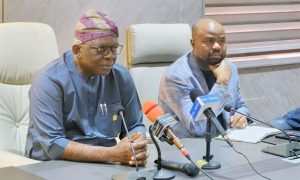
Dr Akutah and Dr Zach Adedeji, Chairman Nigerian Revenue Service(NRS) at a stakeholders’ meeting in Lagos, convened to address waiver related issues on National Single Window
To complement this achievement, the Council is integrating its revenue collection process into the National Single Window(NSW) platform, a move expected to improve transparency, accountability and operational efficiency.
Making Nigerian Ports More Competitive
Reducing the cost of doing business has remained central to the Council’s reform agenda.
Under Akutah’s leadership, bonded terminal invoice charges have been streamlined from 18 different categories to just six, eliminating unnecessary complexities that had burdened importers.
 The Council also abolished unauthorised shipping line surcharges and directed terminal operators to publicly display approved tariffs, ending arbitrary charges and promoting transparency across the ports.
These reforms are gradually creating a more predictable business environment for investors and traders.
Advancing Trade Facilitation
Trade facilitation has equally witnessed notable progress.
Akutah disclosed that all bottlenecks delaying the implementation of the International Cargo Tracking Note (ICTN) have now been resolved.
 When fully operational, the ICTN is expected to improve cargo visibility, strengthen supply chain security, reduce cargo diversion and enhance customs and port operations.
The Council also continues to play an active role in implementing Nigeria’s NSW project, regarded globally as one of the most effective tools for simplifying international trade procedures.
Strengthening Industrial Harmony
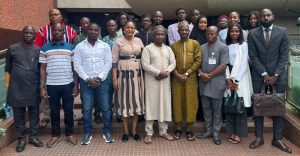 One of the quieter but equally impactful achievements has been the successful negotiation of a new ₦200,000 minimum wage for junior workers in the maritime industry.
The agreement resolved labour issues that had remained unsettled for almost two decades, fostering industrial peace and improving the welfare of workers within the sector.
Expanding Trade Infrastructure
Recognising that efficient logistics extend beyond seaports, the Council has intensified efforts to develop supporting trade infrastructure across the country.
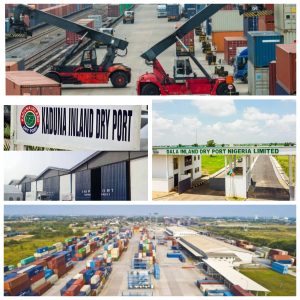 Work is progressing on Inland Dry Ports in Kaduna, Kano and Funtua, alongside the development of Vehicle Transit Areas and Border Information Centres in Idiroko, Jigawa, Benue, Borno and Kebbi States.
Following the collapse of the Jibia Border Information Centre in June 2026, reconstruction has commenced while discussions continue with state governments on permanent facilities that will improve cross-border trade management.
Digital Transformation and Institutional Renewal

Akutah and Board members of NSC
Internally, the council has embarked on an ambitious digital transformation programme.
The deployment of an Enterprise Content Management System has modernised document management and internal processes, while a Leadership and Succession Planning Project is preparing the organisation for its eventual transition into the Nigerian Port Economic Regulatory Agency.
These initiatives reflect a broader commitment to building an institution capable of sustaining reforms beyond the tenure of the current management.
Building Maritime Jurisprudence
 The council is also investing in the legal ecosystem that supports maritime commerce.
From 22 to 24 July 2026, it will host the 18th International Maritime Seminar for Judges in Abuja in collaboration with the National Judicial Institute and the Nigerian Maritime Law Association.
The seminar is expected to attract Chief Justices and senior judicial officers from several African countries, providing a platform for strengthening maritime jurisprudence and promoting consistency in the adjudication of shipping and commercial disputes.
The Road Ahead

For Dr. Pius Akutah, the journey is far from complete.
The anticipated presidential assent to the NPERA Bill, full deployment of the International Cargo Tracking Note, expansion of inland logistics infrastructure and deeper digital integration are among the next milestones expected to define the future of Nigeria’s maritime sector.
If sustained, the reforms currently underway could fundamentally reshape the country’s port economy – reducing business costs, strengthening investor confidence, improving trade efficiency and positioning Nigeria as a more competitive maritime hub in Africa.

At the CMA CGM discussion with NSC on removal of container deposit charges for Nigerian Shippers
By aligning institutional reforms with the Federal Government’s Renewed Hope Agenda, the Nigerian Shippers’ Council is steadily evolving from a dispute resolution agency into a modern, proactive and globally competitive port economic regulator focused on delivering lasting value to shippers, investors and the Nigerian economy.






-

 Crime2 years ago
Imo police confirm arrest of journalist, ‘Nonsonkwa’ over alleged Cyberstalking, Incitement
-
 Education7 months ago
Anambra leads South-east in education allocation ratio, as Imo ranks lowest
-
 News6 years ago
Orthodox Anglican Church, not Same as Church of Nigeria- Bishop
-

 Business6 years ago
Pay-As-You-Go not applicable to pay TV – FCCPC
-

 Agriculture4 years ago
Environment Day: Foundation partners, FCMB, Chevron, harps on collective efforts on earth protection
-

 Crime3 years ago
Pastor allegedly kills female member, prevents 20 year old daughter from attending burial