
Business
NSML training centre ‘ll reduce oversea expenses by 70%
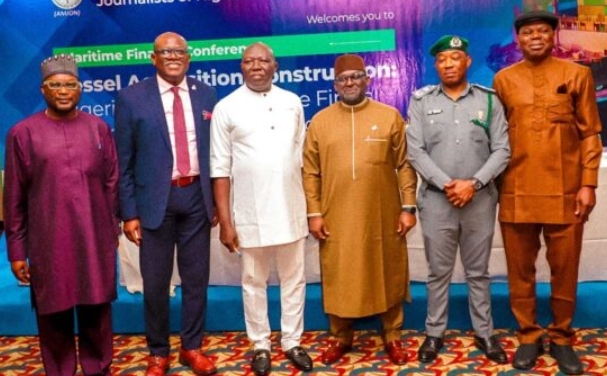
…To boost women involvement in seafaring by 25%
By Ezurike Ugochukwu
Nigerian maritime sector may no longer exponentially cart way scares resources in the name of overseas training for seafarers and cadets with the coming on board and recent accreditation of the Maritime Centre of Excellence(MCOE) an offshoot of the NLNG Shipping and Marine Services Limited (NSML).
NSML said with the domestication of these trainings in Nigeria, over 70 per cent of expenses incurred while on training overseas would now be saved and put into other uses. It beats its chest being the first training Centre in Africa to get certified by the United Kingdom Maritime and Coastguard Agency (UK MCA).

The certification has empowered it to deliver and issue certificates for the STCW 2010 Electronic Chart Display and Information System (ECDIS) and the Basic Liquefied Gas Tanker Cargo Operations courses, placing it among globally recognized maritime training institutions.
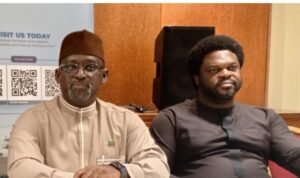
Adbulkadri Ahmed & Dr Effiong
The Managing Director/Chief Executive Officer of NSML, Abdulkadir Ahmed, who made the revelation while speaking with journalists in Lagos stated that MCOE accreditation is one of the highest standards one can ever see in the international level.
He revealed that they parade competent individuals that are constantly being trained, retrained and are kept abreast of new developments to enable them continue to effectively and efficiently manage assets they have in human and material resources.
On what the accreditation implies, he said it offers MCOE opportunity as a fully-fledged and advanced maritime training Centre to train and support their crew, and seafarers across Africa and beyond who would no longer need to spend foreign currencies, and travel abroad to renew their certifications.
Services of NSML Ahmed said are not limited to Nigeria LNG just as NLNG will always remain a core customer, “Our services and activities cut beyond NLNG energy and also it is open to third parties within the Nigerian and African energy logistic business.”
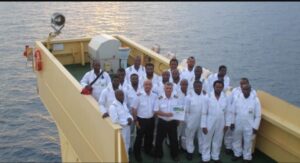
NSML Crew
As vessels owner, NSML train people to be of standard in the maritime centric courses. A typical seafarer he said requires about 20 different international standard certificates to operate.
The international certifications he hinted are for seafarers who are working as officers on-board ships especially international going ships.
Speaking on issues of strict adherence to regulations as key, he said, “Regulation is the beauty of the industry, it is a highly regulated industry and rightly so because safety is critical, reliability is critical and therefore it has to be regulated because any mistake could be catastrophic.”
On starting level for trainees in the MOCE, Ahmed, said they are not undertaking the primary training of seafarers as that could be done by some other training schools.
“We are not in the sphere of baseline maritime training, that’s not the area we ply. We are in the sphere of the advanced specialist training.
“Now you can’t go from secondary school to advanced specialist training. You have to first of all do the basics and the basics are the Certificate of Compliance (COC) level at maritime academies, the Check-ins and other maritime training institutes. So we are plying at a slightly higher level, focusing on specialist courses in line with our business and we are, focused on energy logistics.
“There are other aspects of shipping that we’re not involved in so our center is really focused on energy logistics, shipping and maritime.”
Their vessels he said are in compliant to greener emission policy, he said, “Already, we have started applying a lot of efficiency measures. Our top vessels instead of being run by diesels that generate excessive carbon dioxide(CO2), we use what we call short power, which means we plug electricity and then it reduces emissions by more than 70%. All these are advance plans rather than using 2.0 or any type of fuel.”
NIMASA has continued to spend billions of naira to train seafarers in Philippines, UK and other countries. Records have shown that long ago in 2014, it spent about N32b, while N8m was spent on each trainee.
The NSML boss expressed concern on number of women in the maritime especially seafaring. He revealed plans being positioned to make the system condusive for the womenfolk in an industry seen as male-centric.
To this he said, “I am a diversity champion and a diversity sponsor as well. Over the years the shipping industry has been too male-centric globally.
“Global statistics has shown that less than three percent(3%) of the seafarers are women. It’s not just simply a Nigerian issue, it is not an NSML issue, it’s a global issue. And there are reasons behind that: the contract, the sea. Being at sea is difficult in the simplest of all terms. However, there has been a concerted effort at attracting the female gender into seafaring and we at NSML are taking the lead on that here in Nigeria.
He highlighted efforts in place to increase the number of women seafarers within the shortest time “For us at NSML, in the next five years, we are inching towards having at least 15% of our seafarers as females. You can’t just pluck them from the air. You have to start from the bottom. Currently, when it comes to cadets that go on our vessels, over 25% are female. That’s a starting point.”
On making the sea conducive for the women, those exigencies needed by women as wears and sanitary supplies, he said, “when it comes to Personal Protective Equipment (PPEs) for women, the uniforms and etc., hitherto, you go on-board and you see a lady wearing a man’s boot or a lady wearing a man’s overall, We have changed all of that to ensure that they are gender sensitive.
“Before now, because it was a male-centric environment, you ‘ll be surprised to see the simplest as sanitary wares nobody thought about that, but we now focus on those little things to make it comfortable for women to be at sea. It is difficult as it is, but we shouldn’t make it more difficult for them.”









-

 Crime1 year ago
Imo police confirm arrest of journalist, ‘Nonsonkwa’ over alleged Cyberstalking, Incitement
-

 Business5 years ago
Pay-As-You-Go not applicable to pay TV – FCCPC
-
 News6 years ago
Orthodox Anglican Church, not Same as Church of Nigeria- Bishop
-
 Crime2 years ago
Pastor allegedly kills female member, prevents 20 year old daughter from attending burial
-
 News2 years ago
Ex-TCN Abuja GM, Nwaire wears cap of General Overseer Christian Life Gospel Assembly
-
 News6 years ago
Covid-19: Bishop Onuoha sues for equitable distribution of relief items