
Business
NIMASA’s Public-Private Partnership framework aims to reduce greenhouse gas emissions in naritime industry
By Ezurike Ugochukwu
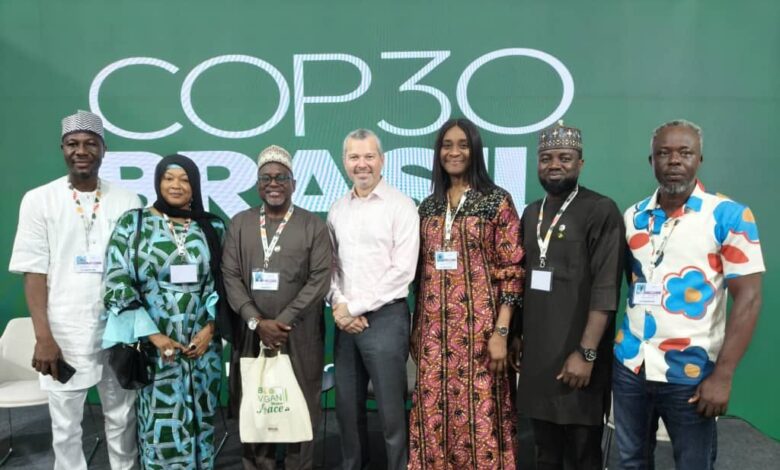
The Nigerian Maritime Administration and Safety Agency (NIMASA) has launched a pioneering Public-Private Partnership (PPP) model for African maritime decarbonisation, showcasing the Nigerian Maritime Continuous Emissions Monitoring System at the UNFCCC COP30 in Belém, Brazil.
The agency presented the model at a side event it hosted during the conference, highlighting Nigeria’s dedication to fast-tracking the International Maritime Organisation’s (IMO) energy-transition agenda via cutting-edge digital solutions.
Speaking on behalf of the Director General, Dr. Dayo Mobereola, the Director of the Marine Environment Management Department, Dr. Oma Ofodile, said the initiative reflects years of consistent investment in maritime energy-transition efforts

She noted that NIMASA has remained “at the forefront” of coordinated actions aimed at converting global climate ambition into verifiable progress through technology-driven emissions tracking.
The announcement marks the latest phase of NIMASA’s multi-year push to strengthen Africa’s contribution to global greenhouse-gas reduction targets. At COP28, the agency championed the formation of an African coalition to support IMO decarbonisation efforts. By COP29, it convened expert discussions and unveiled work on a verifiable Nigerian maritime emissions inventory developed with the University College London (UCL) research group—an effort intended to demonstrate the country’s preparedness for low-carbon shipping.
 At this year’s COP30, NIMASA formally introduced the Continuous Emissions Monitoring System, developed in collaboration with UCL researchers, and outlined concrete measures being taken to advance IMO transition strategies.
IMO representative Roel Hoeders commended NIMASA for “putting together a novel session” that expands technical dialogue and offers a strategic pathway for Africa to manage the complexities of shipping’s energy transition.
The side event drew expert speakers from the IMO, UCL, maritime administrations of Ghana, Kenya and Tanzania, the Lagos State Ministries of Planning and Budget, the Federal Ministry of Marine and Blue Economy, and the Nigerian Ports Authority (NPA), among others.
COP30 negotiators have reached an agreement on indicators for tracking progress toward the Global Goal on Adaptation (GGA) under the Paris Agreement. The finalized list includes 59 indicators, with plans for further refinement over the next two years. This milestone marks a significant step in measuring and guiding global adaptation efforts, particularly for vulnerable communities.
The agreement is part of the broader “Belém-Addis vision,” aiming to enhance adaptation finance and support developing countries in addressing climate change impacts. Despite challenges, including disagreements on adaptation finance and indicator adoption, the outcome is seen as a crucial step forward.











-

 Crime1 year ago
Imo police confirm arrest of journalist, ‘Nonsonkwa’ over alleged Cyberstalking, Incitement
-

 Business5 years ago
Pay-As-You-Go not applicable to pay TV – FCCPC
-
 News6 years ago
Orthodox Anglican Church, not Same as Church of Nigeria- Bishop
-

 Crime2 years ago
Pastor allegedly kills female member, prevents 20 year old daughter from attending burial
-

 News2 years ago
Ex-TCN Abuja GM, Nwaire wears cap of General Overseer Christian Life Gospel Assembly
-
 News6 years ago
Covid-19: Bishop Onuoha sues for equitable distribution of relief items