
Agriculture
Innovation in agriculture: New tool helps farmers uproot cassava with ease

…Innovation holds huge promise for Nigerian farmers
By Ezurike Ugochukwu
A simple, low-cost harvesting device developed by Brazilian family farmers and refined by agricultural researchers is transforming cassava harvesting by significantly reducing the physical effort required to uproot roots without relying on expensive tractors or heavy machinery.
The innovation, developed by researchers at the Urussanga Experimental Station of the Agricultural Research and Rural Extension Company of Santa Catarina (Epagri), combines a metal lever, wheels and a movable claw to help smallholder farmers harvest cassava more efficiently while reducing back strain and manual labour.

The idea originated from practical solutions independently created by farmers across several Brazilian states, including Minas Gerais, Mato Grosso and Santa Catarina. Known locally by names such as “friendly hand,” “cassava puller” and “manioc lever,” the homemade devices all relied on the same mechanical principle—using leverage to multiply force and make uprooting easier.

Recognising the ingenuity of the farmers’ innovations, Epagri engineers refined the concept into a more durable and practical prototype specifically designed for family farms, where access to mechanised harvesting equipment remains limited.
Unlike conventional manual harvesting, which depends almost entirely on physical strength, the new device changes the operator’s posture and reverses the direction of the pulling force, making it easier to lift cassava roots even in compact or dry soils.
A major improvement is the addition of wheels, allowing farmers to move the equipment easily from one plant to another while reducing the effort required to transport it across farms.
The prototype also incorporates a movable claw that firmly grips the cassava stem before lifting. This prevents slippage during harvesting, protects planting stems used for future cultivation and reduces repeated pulling attempts that often lead to fatigue and injury.
According to Epagri, the tool was designed not to replace large commercial harvesters but to provide an affordable alternative for thousands of family farmers who continue to depend on manual harvesting because of the high cost of mechanisation.
Field trials conducted on a family farm in Treze de Maio, Santa Catarina, produced encouraging results.
Farmer Gilmar Damásio, who participated in the tests, said the equipment enabled him to uproot large cassava plants without assistance, particularly during dry conditions when harvesting is usually more difficult.
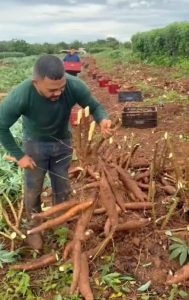
He noted that tasks previously requiring two people could now be completed alone with considerably less strain on the back and shoulders.
Researchers said the positive feedback confirmed the tool’s suitability for small-scale farming, where affordability, simplicity and ease of maintenance are essential.
Although Brazil has mechanised cassava harvesting technologies, researchers noted that many remain beyond the reach of family farmers because they require tractors, large farms and substantial capital investment.
Technical publications from Embrapa also acknowledge that cassava harvesting in many production areas is still carried out manually, with soil conditions and climate significantly influencing the level of effort required.
By combining the proven principles of leverage with wheels and a movable gripping mechanism, Epagri has transformed a farmer-led innovation into a practical, low-cost technology capable of improving productivity, reducing labour intensity and making cassava cultivation more sustainable for smallholder farmers.

Cassava Harvesting in Nigeria
Agricultural experts believe the innovation could have significant relevance beyond Brazil, particularly in major cassava-producing countries such as Nigeria, Ghana and the Democratic Republic of Congo, where millions of smallholder farmers still rely on manual harvesting and face similar labour challenges.










Nigeria Customs, Benin, Cameroon advance one-stop border initiative after Zimbabwe Mission

Kogi mourns Rear Admiral Hamzat Sani, celebrates legacy of patriotism, statesmanship

‘Victory Is within reach,’ Oyebamiji declares as APC launches Osun Campaign Council
-

 Crime2 years ago
Imo police confirm arrest of journalist, ‘Nonsonkwa’ over alleged Cyberstalking, Incitement
-

 Education5 months ago
Anambra leads South-east in education allocation ratio, as Imo ranks lowest
-

 News6 years ago
Orthodox Anglican Church, not Same as Church of Nigeria- Bishop
-

 Business6 years ago
Pay-As-You-Go not applicable to pay TV – FCCPC
-

 Agriculture4 years ago
Environment Day: Foundation partners, FCMB, Chevron, harps on collective efforts on earth protection
-

 Crime3 years ago
Pastor allegedly kills female member, prevents 20 year old daughter from attending burial