
Education
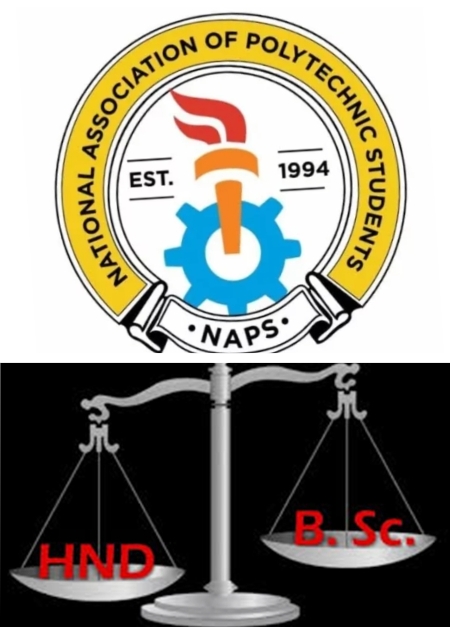
HND-BSc dichotomy: NAPS demands full parity, B.Tech for Polytechnics
By Ezurike Ugochukwu
The National Association of Polytechnic Students (NAPS) has renewed its campaign for an end to the disparity between Higher National Diploma (HND) and Bachelor of Science (B.Sc.) qualifications, while demanding that polytechnics be empowered to award Bachelor of Technology (B.Tech) degrees.
The newly elected National President of NAPS, Jimoh Ibrahim, said the continued differential treatment of HND and university graduates in employment, career progression and further education remained one of the major challenges confronting Nigeria’s technical education system.
Ibrahim, who outlined the priorities of his administration, said NAPS would sustain engagement with the Federal Government, National Assembly and relevant regulatory agencies until polytechnic graduates enjoy parity with their university counterparts.

He described the HND-BSc dichotomy as an injustice that has persisted for too long, arguing that students who undergo rigorous technical and vocational training should not face structural disadvantages simply because they attended polytechnics.
According to him, the issue extends beyond the nomenclature of qualifications to the practical consequences of the disparity, particularly in public-sector employment, promotion, career advancement and admission into postgraduate programmes.
NAPS rejects conversion of polytechnics
Ibrahim also rejected the growing practice of converting polytechnics into conventional universities, arguing that such a policy could weaken the technical orientation of the institutions.
Instead, he called on the Federal Government to retain and strengthen polytechnics while granting them the authority to award B.Tech degrees.
“A country genuinely committed to technological advancement and economic prosperity does not diminish its polytechnics; it strengthens them,” he said.
He argued that B.Tech-awarding polytechnics would preserve the institutions’ practical and technology-driven character while providing graduates with a degree qualification that better reflects their training.
The NAPS president said polytechnics remain indispensable to Nigeria’s industrialisation because they produce technical manpower required in manufacturing, construction, agriculture, ICT and other sectors of the economy.
He warned that converting or neglecting polytechnics without addressing their underlying challenges could undermine the country’s efforts to build the skilled workforce required for economic transformation.
Calls for stronger technical education

Ibrahim called for increased government investment in modern laboratories, workshops, digital infrastructure and equipment to reposition polytechnics for contemporary technological demands.
He also advocated stronger partnerships between polytechnics and industries, saying such collaboration would expose students to practical workplace experience while enabling institutions to align their curricula and research with the needs of the economy.
According to him, research carried out in polytechnics should increasingly translate into practical and commercially viable solutions for industry and society.
The NAPS leader further called for an overhaul of policies that, in his view, continue to undermine the attractiveness and competitiveness of polytechnic education.
TVET initiative
On the Federal Government’s Technical and Vocational Education and Training (TVET) initiative, Ibrahim commended President Bola Ahmed Tinubu for placing greater emphasis on skills acquisition as a pathway to employment and economic development.
He, however, warned institutions against exploiting students participating in TVET programmes through inappropriate charges.
“To every institution exploiting students under the guise of implementing TVET, this administration serves notice that such practices must stop immediately. Education interventions designed to empower students must never become avenues for exploitation,” he said.

He said NAPS would deploy constitutional and democratic mechanisms, including advocacy, protests and legal action where necessary, to challenge practices it considers detrimental to students.
Five-point agenda
Ibrahim said his administration would pursue a five-point agenda centred on students’ welfare, educational reform, institutional strengthening, capacity building and strategic partnerships.
He said the leadership would also focus on tackling chronic underfunding, deteriorating infrastructure, obsolete equipment and weak industry linkages across polytechnic institutions.
The NAPS president urged policymakers to view technical education as a strategic component of Nigeria’s economic development rather than a second-tier alternative to university education.

He said strengthening polytechnics and ending discriminatory treatment of their graduates would encourage more young Nigerians to pursue technical careers and provide the country with the skilled workforce needed for industrial growth.
Ibrahim also commended security agencies, particularly the Department of State Services (DSS), for supporting the association’s national convention that produced the new executive.
He pledged that the new leadership would remain focused on defending the interests of polytechnic students while pursuing reforms aimed at restoring confidence in technical and vocational education across the country.













-

 Crime2 years ago
Imo police confirm arrest of journalist, ‘Nonsonkwa’ over alleged Cyberstalking, Incitement
-

 Business1 year ago
Kirikiri Lighter Terminal Customs achieves 63% revenue growth in first half of 2025, generates ₦89.2b
-

 Business1 year ago
Nigerians can now independently verify vehicle duty payment status online with ₦15,000
-

 Business3 years ago
Floating Naira: Imminent drawback to revenue as Customs Duty Exchange Rate rises again to ₦783.174
-

 Education8 months ago
Anambra leads South-east in education allocation ratio, as Imo ranks lowest
-

 Crime6 years ago
EFCC: “Why Magu’s confirmation was turned down by Senate”