“The refinery’s coastal location positions it within the Gulf of Guinea shipping corridor”
By Ezurike Ugochukwu
The integration of the East-West Offshore Gas Pipeline into the operations of the Dangote Petroleum Refinery took centre stage last Tuesday 17 February, 2026 as the refinery’s Chief Executive
Officer(CEO), David Bird, addressed members of Maritime Correspondents’ Organisation of Nigeria (MARCON) and other journalists at the end of a one day facility tour of the refinery.
The CEO while briefing the journalists underscored how offshore energy infrastructure now directly feeds Nigeria’s expanding maritime export ecosystem.
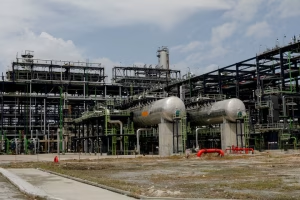
Interacting with the journalists, Bird described the refinery as “a fully integrated industrial and maritime hub,” noting that stable gas supply from the East-West Offshore Gas Pipeline is fundamental to maintaining seamless refining and marine export operations.
According to him, the $20 billion Dangote Refinery has reinforced its identity as a global merchant refinery built around maritime logistics.
He emphasized, “It is a merchant refinery where maritime logistics, storage and export capability are central to the business model. The siting and deep-sea infrastructure were intentional, enabling operational flexibility and efficient cargo handling.”

Bird assured that the refinery’s port which has handled about 800 vessels since inception is striving hard to receive around 600 vessels this year, creating opportunities for jobs, local content and ancillary maritime services.
He said, “Energy stability is critical for us. When you are running at this scale, especially as a major exporter, you cannot afford disruptions.”

According to an engineer, staff guide on the tour, the pipeline runs through their corridor and supplies the gas that powers thier operations.
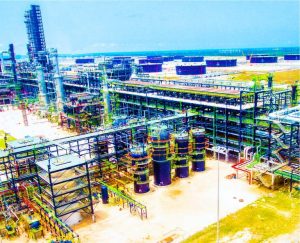
The gas supplied via the offshore network fuels the refinery’s captive power plant : a combined-cycle system generating between 435MW and 570MW – ensuring independence from the national grid.
A senior plant engineer who also briefed the delegation said waste heat recovery through steam turbines further optimises efficiency.
“We generate our own power here, eight gas turbines and four steam turbines give us the reliability we need. That reliability directly supports marine loading schedules and vessel turnaround times.”
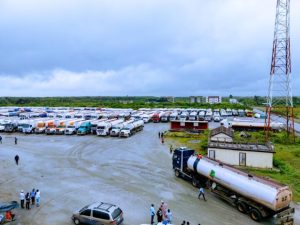
Tankers waiting to load at Dangote refinery
He asserted that this feat breads uninterrupted refining operations translating into consistent cargo availability for tanker traffic.
Bird noted that Nigeria’s maritime trade balance is already shifting as refined petroleum products now leave Nigerian shores in increasing volumes.
“Before this refinery came onboard, Nigeria exported crude but imported most of its refined products. Today, we are supplying not just Nigeria but international markets. That changes the conversation for our ports and shipping,” he said.
Officials disclosed that hundreds of vessels have already berthed to lift products, marking a significant milestone for a refinery that only recently achieved full operational capacity of 650,000 barrels per day, the largest single-train refinery output globally.
Further asserted that the refinery’s coastal location positions is within the Gulf of Guinea shipping corridor, one of Africa’s most strategic maritime trade routes. Bird emphasised that energy and maritime planning were deliberately integrated from inception.
As it’s believed that stable pipeline-fed operations reduce volatility in shipment cycles, giving shipowners and charterers greater predictability.
“We built not just a refinery, but the supporting infrastructure including marine facilities and jetty systems to ensure we can move products efficiently,” he said.
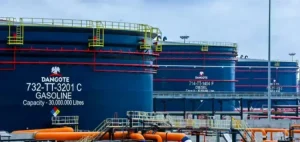
A marine operations manager added: “The synergy between pipeline supply and port logistics ensures we can sustain exports even during fluctuations. Our storage capacity provides buffer for up to 20 days of supply without disruption.”
During the tour, environmental compliance was also highlighted as part of the integration model. Staff explained that gas flaring is conducted strictly under global safety protocols, while cooling towers regulate pipeline temperatures to prevent system stress.
“We test everything before discharge. Our water treatment systems ensure there is no harm to aquatic life. Maritime sustainability is part of our operational philosophy,” a laboratory supervisor told the delegation.
Bird reinforced that adherence to international standards is non-negotiable. “Our lenders and global partners require compliance with World Bank, US EPA, and EU emission standards. Maritime trade today demands environmental responsibility.”
“This is about more than refining crude, it’s about positioning Nigeria as a reliable supplier within global maritime trade routes.”
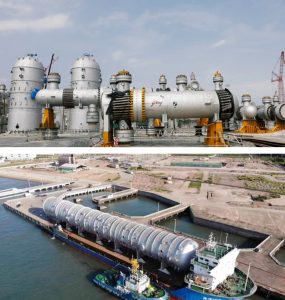
According to a renowned maritime journalists and President of MARCON, Mr. Ismail Aniemu, the refinery’s integration with offshore gas pipelines represents a structural shift in Nigeria’s energy–maritime architecture. By aligning upstream offshore gas flows with downstream port exports, the facility strengthens Nigeria’s standing as a refining and shipping hub in West Africa.
He reiterated that Nigeria’s offshore pipelines and port infrastructure are no longer operating in parallel, they are now strategically intertwined.












 Crime2 years ago
 Education7 months ago
 News6 years ago
 Business6 years ago
 Agriculture4 years ago
 Crime3 years ago