
Crime
Customs rejects allegations of smuggling surge, revenue leakage, recruitment fraud

…Defends 846 valuation system, recruitment process and succession policy
By Ezurike Ugochukwu
The Nigeria Customs Service (NCS) has rejected allegations of a surge in smuggling, revenue leakage, recruitment impropriety and manipulation of succession within the Service, describing the claims as a misrepresentation of its enforcement activities and administrative processes.
The Service said its operations remained guided by established laws, digital controls, institutional oversight and accountability mechanisms, while insisting that any officer or stakeholder found culpable of misconduct would face disciplinary action and prosecution.

The National Public Relations Officer of the Service, Deputy Comptroller Abdullahi Maiwada, stated this in a detailed response issued on Thursday to an investigative report published by a media outlet on August 7, 2026.
The report had alleged intensified smuggling along the Seme, Idiroko, Ilaro, Ipokia and Igbeti-Kishi corridors, as well as manipulation of the 846 valuation code at the Apapa, Tin Can Island and PTML Area Commands.
Maiwada, however, said the allegation of increased smuggling was inconsistent with the Service’s enforcement activities, pointing to seizures regularly recorded along the affected corridors.

“Our responsibility is to reduce smuggling to the barest minimum, not to claim that it can be completely eradicated,” he said.
The Service’s position comes against the backdrop of continuing enforcement operations along the nation’s borders. In June, Customs reported 65 seizures of vegetable oil products in 2025 and another 23 in 2026, with several of the seizures recorded along the Seme and Idiroko corridors and a combined duty-paid value of about N1.314 billion.
This, the Service argued, underscores the continuing nature of its anti-smuggling operations rather than evidence of an unchecked escalation.
Customs explains 846 valuation code
On the allegation of manipulation of the 846 valuation code, the NCS explained that the system was specifically designed to process vehicles with non-standard or non-compliant Vehicle Identification Numbers (VINs), including specialised heavy equipment, classic vehicles and customised models.

“The 846 code is an established digital valuation code within the Customs portal, specifically designated for vehicles with non-standard or non-compliant Vehicle Identification Numbers,” Maiwada said.
According to him, vehicles with standard VINs are assessed automatically through manufacturer-linked databases, while applications under the 846 procedure are subjected to secondary approval by valuation officers and Customs Area Controllers.
The Service said post-clearance audits could expose discrepancies in declarations or assessments, in which case Demand Notices could be issued to recover short-collected duties, alongside sanctions where appropriate.
The explanation also has a historical context. The NCS introduced its VIN valuation system as a technology-driven mechanism for valuing imported vehicles, while non-standard VINs that could not be matched with available databases were processed through code 846. A Customs publication in 2023 described the system as being linked to global VIN databases and said the 846 process required approval by the relevant Customs command.
The 846 procedure has previously generated controversy among vehicle importers and customs agents. In August 2023, licensed agents publicly faulted aspects of its implementation after Customs raised concerns about the utilisation of approved values under the procedure.
Similarly, in August 2025, the PTML chapter of the Association of Nigeria Licensed Customs Agents announced that the 846 window had been reopened for applicable vehicles following engagements with Customs.
The NCS said the present digital framework was intended to strengthen valuation controls, reduce human interference and protect government revenue, rather than facilitate revenue leakage.
Recruitment allegations

On the recruitment of Assistant Superintendents of Customs II (ASC II), the Service said the exercise was conducted under the authorisation of the Nigeria Customs Service Board and in accordance with the Nigeria Customs Service Act 2023 and Federal Character Commission guidelines.
It said successful candidates received provisional offers subject to medical verification, background checks and formal acceptance.
The explanation follows the conclusion of the 2024/2025 recruitment exercise, for which the Service released the final list of successful ASC II candidates in July 2026. Candidates were directed to verify their status through official channels and complete medical and other documentation requirements before proceeding to the next stage.
The recruitment process has previously attracted misinformation. In July 2025, Customs publicly disowned a fake CBT shortlist circulating online, warning applicants to rely only on the Service’s official platforms and recognised national newspapers for recruitment information.
Earlier, the Federal Ministry of Information reported that the recruitment exercise had attracted 573,523 applications for 3,927 vacancies, with 286,697 candidates shortlisted for the CBT stage. The government said the process was designed to be merit-driven and transparent.
No manipulation of succession, promotions – Customs

The Service also rejected allegations of manipulation of its succession structure and favouritism in the promotion of officers.
Maiwada said promotions were determined by seniority, merit, promotion examinations and available vacancies in accordance with established regulations.
“Succession and promotion within the Service are governed by established rules and career progression structures, not personal preference,” the Service said.
The NCS pointed to the Nigeria Customs Service Board’s November 2025 approval of strategic leadership appointments as part of the institutional framework for managing career progression. The Board at the time confirmed five Deputy Comptroller-Generals and eight Assistant Comptroller-Generals and approved special promotions for 10 officers.
Maiwada further explained that leadership training for Deputy Comptrollers was part of the Service’s human-capital development programme, designed to strengthen expertise in trade operations, intelligence management and executive leadership.
He said approved training programmes and international exposure were funded through budgetary provisions or formal technical-assistance arrangements with partner institutions.
Oversight, investigations
On calls for independent investigation, the Customs spokesman said the Service remained subject to oversight by the Federal Ministry of Finance, the National Assembly, the Office of the Auditor-General for the Federation and anti-corruption agencies.
The position is significant given that Customs’ revenue administration has previously come under parliamentary scrutiny.
In June 2026, for instance, the Senate Committee on Public Accounts cleared the Service of an allegation that it failed to remit N62.2 billion to the Federation Account after examining audit queries relating to earlier years, although lawmakers subsequently set up an ad hoc panel to review 76 other outstanding queries.
Similarly, the House of Representatives in March 2026 directed Customs and other relevant agencies to submit comprehensive records as part of an investigation into alleged revenue leakages associated with export proceeds and pre-shipment inspection.
Against this background, the NCS said it maintained a “firm, intolerant posture” toward corruption, revenue leakage and administrative misconduct.
It stressed that any officer, importer, agent or other stakeholder found culpable would face appropriate disciplinary measures and, where necessary, prosecution in accordance with the law.
The Service also assured Nigerians that it would cooperate with any legitimate investigation undertaken by a competent statutory authority.
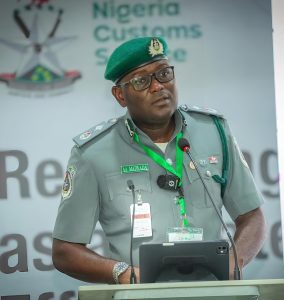
Maiwada
While rejecting the allegations contained in the August 7 report, Customs maintained that its enforcement, valuation, recruitment and promotion systems were subject to institutional controls and oversight, insisting that legitimate scrutiny remained welcome but should be based on verifiable facts and the established processes governing the Service.








Seme–Krake: Nigeria, Benin Customs begin push for seamless border trade
AMJON Conference: NIMASA, Customs, NPA, NSML push innovation, digital skills for future-ready maritime sector

Customs: Discipline, character critical as 2025 recruitment screening enters final phase
-

 Crime2 years ago
Imo police confirm arrest of journalist, ‘Nonsonkwa’ over alleged Cyberstalking, Incitement
-
 Education7 months ago
Anambra leads South-east in education allocation ratio, as Imo ranks lowest
-

 News6 years ago
Orthodox Anglican Church, not Same as Church of Nigeria- Bishop
-

 Business6 years ago
Pay-As-You-Go not applicable to pay TV – FCCPC
-

 Agriculture4 years ago
Environment Day: Foundation partners, FCMB, Chevron, harps on collective efforts on earth protection
-

 Crime3 years ago
Pastor allegedly kills female member, prevents 20 year old daughter from attending burial