
News
Catholic Bishops’ criticism should prompt policy review, says CCN President
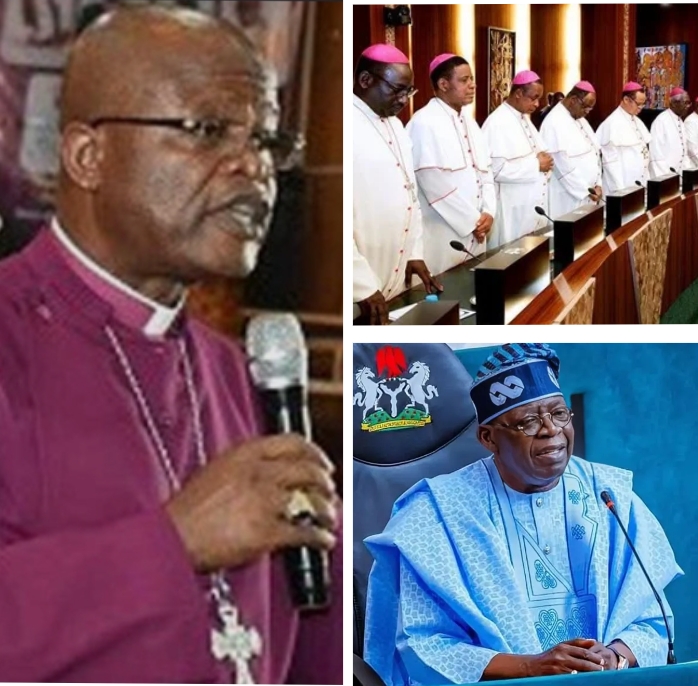
By Ezurike Ugochukwu
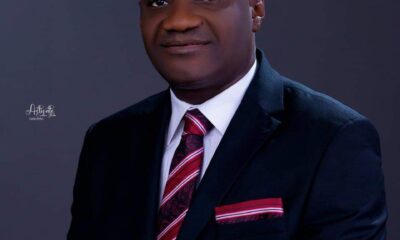
The President of the Christian Council of Nigeria (CCN), Most Rev. Dr. David O. C. Onuoha, has urged the Federal Government to treat the recent intervention by the Catholic Bishops’ Conference of Nigeria (CBCN) as a call for policy review rather than an attack on the administration, saying the concerns raised by the bishops reflect the realities confronting Nigerians.
Onuoha, who spoke in Owerri, described attempts to politicise the bishops’ submission to President Bola Ahmed Tinubu as “rather unfortunate”, insisting that the Catholic bishops spoke on issues affecting Nigerians across religious, ethnic and political divides.
According to him, the issues raised by the bishops were not limited to the interests of the Catholic Church but concerned the welfare and security of citizens nationwide.

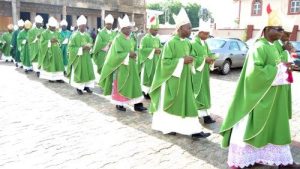
Precession of Roman Catholic Church Bishops
“The truth remains that the Roman Catholic Bishops Conference spoke not for the Church or any other body, but for the entire nation,” Onuoha said.
“The matters they raised before the President were real, and affect every Nigerian, irrespective of tribe, religion or ethnicity.”
 The CCN president said the Federal Government should see the Church as a partner in governance and national development rather than respond defensively to its criticisms.
He urged the administration to acknowledge the hardship, poverty, insecurity and other socioeconomic difficulties confronting citizens and use such feedback to reassess policies whose effects may not have met their intended objectives.
“Rather than castigate them or live in denial of the pain, suffering, hardship, poverty and insecurity that are a present reality in Nigeria today, the Federal Government should see the Church as a partner in the search for a Nigeria that works,” he said.
Archbishop Onuoha who is also the Archbishop of the Owerri Ecclesiastical Province of the Anglican Communion argued that religious leaders were particularly positioned to provide an accurate picture of conditions across the country because of their close relationship with communities.
“Religious leaders are in constant touch with the people, both in the urban and rural areas. They live among them, and should be trusted for an unbiased assessment of how government policies affect the people of this nation,” he said.
 He also cautioned President Tinubu against officials who, in their efforts to defend the administration, could end up shielding the government from the realities experienced by ordinary Nigerians.
“The President should be wary of those assistants and staff who make enemies for the administration in the guise of defending the government,” he warned.
“Those around the President, who present false pictures of the situation of things in the country in order to keep their positions and offices, are the real enemies of the people.”
The cleric stressed that leaders committed to public welfare must possess the courage to listen to criticism and accept the truth regardless of its source.
He cited the biblical injunction that “you shall know the truth and the truth shall set you free”, arguing that constructive criticism should be regarded as an opportunity to correct policy deficiencies rather than an act of political opposition.
Onuoha commended the Catholic Bishops’ Conference for what he described as its consistent, bold and courageous interventions on national issues, particularly those affecting the welfare and security of Nigerians.
“The Catholic Bishops Conference of Nigeria should be commended for its constant, bold and courageous interventions for the wellbeing of the nation,” he said.
He warned that vilifying individual bishops or dismissing their concerns could undermine constructive engagement between government and religious institutions, which he described as important stakeholders in addressing Nigeria’s social and economic challenges.

According to him, failure to listen to credible voices expressing public concerns could ultimately undermine the effectiveness of government policies and deepen the difficulties facing citizens.
Onuoha was particularly critical of the impact of government policies and reforms over the past three years, arguing that the welfare of Nigerians should be the ultimate yardstick for measuring their success.
“For the avoidance of doubt, government policies and reforms in the last three years have produced more adversity than prosperity,” he said.
He consequently called for a comprehensive review of policies that have imposed hardship on citizens, alongside stronger measures to address insecurity and improve living conditions.
He said such a review was not a sign of weakness but a necessary response to changing circumstances and evidence from citizens affected by government decisions.
According to the CCN president, ensuring that Nigerians are safe, secure and able to benefit from economic reforms should remain the central objective of governance.
 He urged the federal government to broaden its consultations with religious leaders, civil society groups and other stakeholders, stressing that constructive engagement and willingness to review policies would strengthen public confidence and improve the chances of achieving sustainable national development.







Seme–Krake: Nigeria, Benin Customs begin push for seamless border trade
AMJON Conference: NIMASA, Customs, NPA, NSML push innovation, digital skills for future-ready maritime sector

Customs: Discipline, character critical as 2025 recruitment screening enters final phase
-

 Crime2 years ago
Imo police confirm arrest of journalist, ‘Nonsonkwa’ over alleged Cyberstalking, Incitement
-
 Education7 months ago
Anambra leads South-east in education allocation ratio, as Imo ranks lowest
-

 News6 years ago
Orthodox Anglican Church, not Same as Church of Nigeria- Bishop
-
 Business6 years ago
Pay-As-You-Go not applicable to pay TV – FCCPC
-

 Agriculture4 years ago
Environment Day: Foundation partners, FCMB, Chevron, harps on collective efforts on earth protection
-
 Crime3 years ago
Pastor allegedly kills female member, prevents 20 year old daughter from attending burial