
Business
Middle managers key to NSC reform success, Akutah declares
By Ezurike Ugochukwu
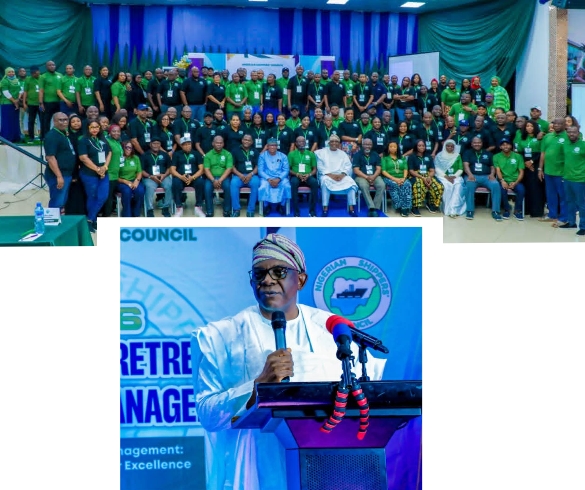
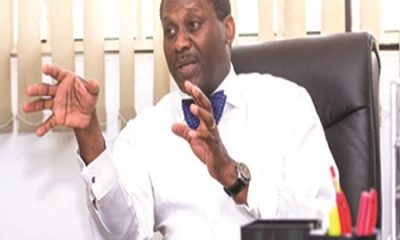
The Executive Secretary and Chief Executive Officer of the Nigerian Shippers’ Council (NSC), Dr. Akutah Pius, has described middle-level management officers as the driving force behind the Council’s ongoing transformation agenda, saying the success of institutional reforms will depend largely on their leadership, innovation and ability to translate policy into measurable results.
Speaking at the opening of the Operational Retreat for Grade Level 12–14 officers in Abeokuta, Ogun State, Dr. Akutah also unveiled a new Retreat Governance and Performance Management Policy aimed at ensuring that decisions reached during retreats are fully implemented and aligned with the Council’s strategic objectives.
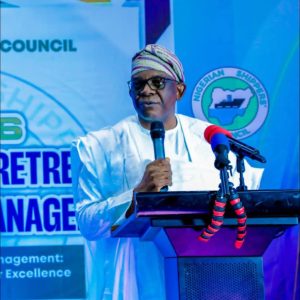 The NSC chief executive said the retreat was more than a routine capacity-building programme, describing it as a strategic investment in leadership development, succession planning and institutional sustainability.

According to him, middle managers occupy a unique position within the organisation as the critical link between executive vision and operational execution.
“Middle management officers are central to the achievement of the Council’s strategic objectives. They are the bridge between vision and execution, and their effectiveness will determine the pace and success of our institutional reforms,” he said.
Dr. Akutah noted that the Council operates in a rapidly evolving environment shaped by technological advancement, changing global trade patterns, increasing stakeholder expectations and growing demands for transparency and accountability.
 He therefore urged participants to demonstrate discipline, professionalism, integrity, innovation and adaptability in carrying out their responsibilities, stressing that institutional excellence can only thrive where accountability and high standards are upheld.
The Executive Secretary challenged officers to move beyond routine administration by embracing problem-solving, taking ownership of assignments and adopting innovative approaches capable of improving operational efficiency and service delivery.
He also encouraged greater deployment of technology across the organisation while promoting collaboration, mentorship and knowledge sharing among departments.
“No department can effectively deliver the Council’s mandate in isolation. Collaboration, mentorship and deliberate knowledge transfer are necessary to ensure institutional continuity and sustainable growth,” he stated.
In a major policy announcement, Dr. Akutah introduced the Retreat Governance and Performance Management Policy, a framework designed to ensure that resolutions from management retreats are translated into concrete actions.
He explained that the policy would align retreat outcomes with the Council’s 2025–2029 Strategic Plan, departmental deliverables, Key Performance Indicators (KPIs) and individual staff performance targets.
 To drive implementation, he announced the establishment of a Retreat Steering Committee, supported by the Strategic Planning and Research Department (SPRD) and the Human Resources Management Department, to oversee monitoring, compliance and evaluation of retreat resolutions.
According to him, the framework is intended to eliminate the gap between planning and execution while promoting measurable institutional improvements.
Dr. Akutah expressed confidence that the retreat would equip participants with new leadership skills, practical insights and renewed commitment to advancing the Council’s mandate as Nigeria’s Port Economic Regulator.
 Earlier, Director of Strategic Planning and Research, Mr. Olurotimi Anifowose, urged participants to embrace professionalism, accountability, innovation and teamwork as essential values for institutional success.
He stressed that lasting organisational impact is measured not merely by positions occupied but by the quality of leadership demonstrated, the people mentored and the systems strengthened.
Anifowose encouraged participants to actively mentor younger officers, foster collaboration and avoid unhealthy rivalry, noting that such values are critical to building a resilient institution.
 Also speaking, maritime policy analyst and Lead Consultant for the retreat, Dr. Williams Azuh, described middle management officers as the “midfielders” of every successful organisation whose role in driving performance and achieving strategic goals cannot be overstated.
Presenting a paper titled “From Operational Overseers to Strategic Analysts,” Azuh challenged participants to evolve from routine supervisors into strategic leaders capable of driving innovation, improving organisational performance and delivering lasting value to the Nigerian Shippers’ Council.







-

 Crime2 years ago
Imo police confirm arrest of journalist, ‘Nonsonkwa’ over alleged Cyberstalking, Incitement
-
 Education7 months ago
Anambra leads South-east in education allocation ratio, as Imo ranks lowest
-

 News6 years ago
Orthodox Anglican Church, not Same as Church of Nigeria- Bishop
-
 Business6 years ago
Pay-As-You-Go not applicable to pay TV – FCCPC
-

 Agriculture4 years ago
Environment Day: Foundation partners, FCMB, Chevron, harps on collective efforts on earth protection
-

 Crime3 years ago
Pastor allegedly kills female member, prevents 20 year old daughter from attending burial