
Business
Customs, PEBEC target faster cargo clearance through technology
By Ezurike Ugochukwu
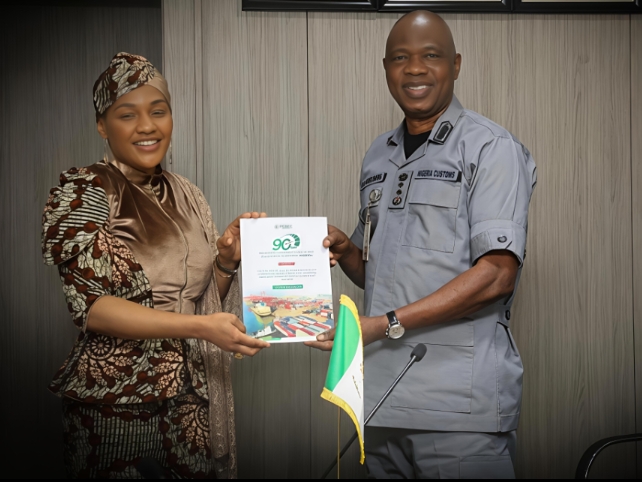
The Nigeria Customs Service and the Presidential Enabling Business Environment Council (PEBEC) have strengthened collaboration to accelerate digital transformation across Nigeria’s ports, with a focus on eliminating paperwork, improving cargo clearance efficiency, and enhancing the ease of doing business.
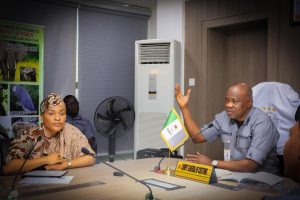 This commitment was reaffirmed when the Comptroller-General of Customs, Adewale Adeniyi, received the Director-General of PEBEC, Zahrah Audu, during a high-level strategic meeting at the Customs Headquarters in Abuja.
Adeniyi said the Service remains committed to establishing a fully paperless port environment as part of broader reforms aimed at removing bureaucratic bottlenecks and repositioning Nigeria as a competitive hub for global trade.

According to him, the Customs Service has institutionalised regular engagements with key stakeholders, including the American Business Council and other trade associations, to address operational challenges and strengthen cooperation within the trade ecosystem.
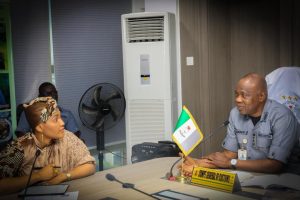 “Such consultations allow the Service to identify operational bottlenecks and obtain direct feedback from businesses that interact with Customs at the nation’s ports,” Adeniyi said.
The Customs boss also disclosed that the Service, in collaboration with the World Customs Organization, recently conducted a Time Release Study (TRS) to scientifically measure the time and costs involved in cargo clearance processes at Nigerian ports.
Using Tin Can Island Port as a case study, the study involved shipping companies, terminal operators, the Nigerian Ports Authority, licensed customs agents, and financial institutions. The report was publicly launched on January 26, 2026.
“We deliberately involved every segment of the port community in the exercise so that the findings would reflect the real operational environment. The report has already provided valuable insights that are guiding some of the reforms we are implementing,” Adeniyi explained.
He noted that while some stakeholder concerns have already been addressed, others would continue to inform future reforms by the Service.
On the issue of 24-hour port operations, Adeniyi said successful implementation requires full participation from all operators across the logistics chain.
 He explained that earlier efforts by the Service to deploy officers for round-the-clock operations encountered challenges because other critical actors, including banks, shipping companies, and terminal operators, were not fully integrated into the system.
According to him, most core Customs processes have already been digitised, including pre-arrival documentation, cargo declarations, duty payments, and release communications.
“Where delays still occur, they are often linked to operators who continue to rely on physical documentation. That is an area we intend to address in the coming months,” he added.
Adeniyi also highlighted ongoing investments in scanning technology and ICT infrastructure aimed at strengthening risk-based cargo management and reducing reliance on physical cargo examinations.
He noted that development partners such as the World Bank, International Monetary Fund, and World Trade Organization have encouraged Nigeria to expand the use of non-intrusive inspection technology in line with international best practices.
Earlier, PEBEC Director-General Zahrah Audu said the Council is currently implementing a 90-day Business Environment Enhancement Programme designed to address operational challenges identified in its Business Facilitation Compliance Report released in November 2025.
According to her, the initiative aims to improve efficiency across business-facing government agencies through closer collaboration to remove bottlenecks affecting Nigeria’s business environment.
As part of the programme, Audu said PEBEC recently conducted a three-day operational assessment at Lagos ports in collaboration with the Nigerian Ports Authority.
The exercise involved observing cargo handling processes from vessel arrival to cargo exit, as well as consultations with regulators and private sector stakeholders.
“The exercise enabled us to identify key operational challenges affecting port efficiency and to develop practical recommendations for improvement,” she said.
Among the key issues highlighted were the need for stronger coordination in joint vessel boarding by regulatory agencies, improved cargo inspection processes, and increased deployment of technology in port operations.
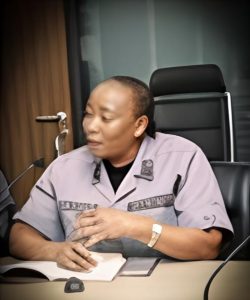
Also speaking, the Deputy Comptroller-General of Customs in charge of ICT and Modernisation, Oluyomi Adebakin, said vessel arrival schedules already provide sufficient data for effective operational planning at the ports.
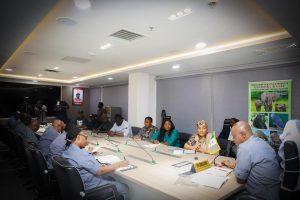 She noted that better use of such information would allow the Service to strategically deploy personnel rather than stationing officers at terminals while waiting for vessels.
“The concept of 24-hour port operations should focus on smarter deployment of personnel based on vessel schedules, not merely extending working hours,” Adebakin said.
She also reaffirmed the Service’s readiness to address operational issues raised through the PEBEC reporting platform, stressing that sustained collaboration between the two institutions is essential for improving port efficiency and strengthening Nigeria’s business environment.
Meanwhile, the Deputy Comptroller-General in charge of Tariff and Trade highlighted several trade facilitation initiatives introduced by the Service to expedite cargo clearance for trusted traders.
These include the Authorised Economic Operator programme, Advance Ruling systems, and the One-Stop-Shop platform, all designed to support the Federal Government’s goal of improving trade efficiency and strengthening Nigeria’s competitiveness in global commerce.












No-winner verdict triggers record 237 entries in NLNG science, innovation prize

Neutrality has expired,’ Cleric tells christians at Lagos West Synod, five dioceses gather

Adeniyi unveils customs digital gains, showcases B’Odogwu at UNILORIN conference
-

 Crime2 years ago
Imo police confirm arrest of journalist, ‘Nonsonkwa’ over alleged Cyberstalking, Incitement
-

 News6 years ago
Orthodox Anglican Church, not Same as Church of Nigeria- Bishop
-

 Business6 years ago
Pay-As-You-Go not applicable to pay TV – FCCPC
-

 Crime3 years ago
Pastor allegedly kills female member, prevents 20 year old daughter from attending burial
-

 News2 years ago
Ex-TCN Abuja GM, Nwaire wears cap of General Overseer Christian Life Gospel Assembly
-
 News6 years ago
Covid-19: Bishop Onuoha sues for equitable distribution of relief items