
Business
Adeniyi’s tenure extension may have saved customs from costly succession crisis
By Ezurike Ugochukwu
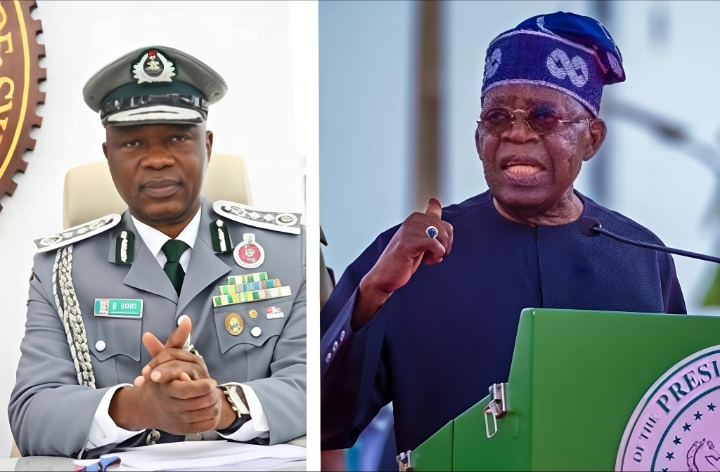
President Bola Ahmed Tinubu’s decision to grant a final six-month tenure extension to the Comptroller-General of the Nigeria Customs Service (NCS), Bashir Adewale Adeniyi, may have achieved more than ensuring continuity in ongoing reforms.
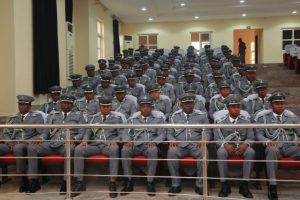
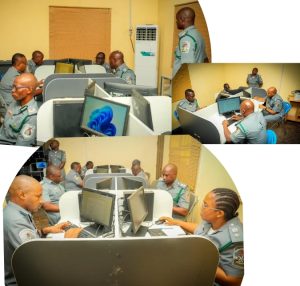
Customs senior officers
Stakeholders also believe it has prevented a potentially disruptive succession crisis that could have led to the premature exit of hundreds of senior Customs officers and destabilised one of Nigeria’s most strategic institutions.
The issue has reopened a longstanding debate about leadership succession in Nigeria’s security and paramilitary agencies, where the appointment of relatively junior officers over their seniors has often triggered mass retirements, internal resentment and loss of institutional memory.


Within the Customs Service, one of the most notable examples occurred in October 2015 when the administration of former President Muhammadu Buhari appointed retired Colonel Hameed Ali as Comptroller-General of Customs. Shortly thereafter, the Service announced the retirement of 34 senior officers, including five Deputy Comptrollers-General : John Atte, Ibrahim Mera, Musa Tahir, Austin Nwosu and Akinade Adewuyi – as part of a reorganisation exercise.
While Customs authorities defended the move as necessary for restructuring, just in thier usual signature, “all correct sir”, Nigerians argued that the mass exit of highly experienced officers deprived the Service of valuable expertise accumulated over decades.
The Nigerian Police Force(NPF) has also witnessed similar controversies. In recent years, debates over tenure extensions and succession have repeatedly generated concerns among senior officers.
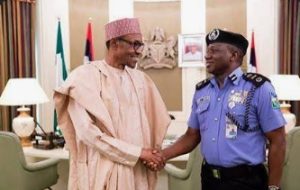
Late former President Buhari and Idris
In June 2016, when AIG Ibrahim Kpotun Idris was appointed acting IG after Solomon Arase’s retirement, Police Service Commission(PSC) compulsorily retired 21 Assistant Inspectors-General(AIG) of Police who were senior in rank to Idris.
In 2025, the PSC ordered the retirement of officers who had exceeded the statutory age or service limits, a move that effectively removed many senior officers who were contemporaries of Inspector-General of Police Kayode Egbetokun, even as legislative provisions allowed him to remain in office. The development sparked widespread debate within policing circles over fairness, succession planning and institutional morale.
It is against this backdrop that many Nigerians view the Customs succession question with caution.
While every President or appointing authority reserves the right to choose the head of an agency, such decisions must always be guided by merit, competence, institutional stability, and the national interest rather than sacrificing national interest in the alter of personal relationships, ethnic considerations, political patronage, or other narrow interests.

Hon. Leke Abejide, House of Representatives Committee Chairman on Customs & Excise
Indeed, the on going debate on NCS leadership whether such were real or merely speculative, the reaction itself underscores the importance officers place on fairness and established succession traditions as highlighted by few officers who spoke with Nationupdate.
Had such an appointment occurred, it could have resulted in the premature retirement of hundreds of experienced officers, thereby creating a significant vacuum within the service. No institution can easily absorb the loss of such a large pool of trained personnel without consequences for efficiency and continuity.
 Such situations can be appropriate only under exceptional circumstances: where there are clear issues of integrity, disciplinary concerns, professional competence or urgent institutional reforms that justify departing from established succession norms. Even then, transparency and public confidence are essential.
However, where appointments are perceived to be driven by ethnic considerations, personal relationships, political patronage or sectional interests, the consequences can be severe. Morale suffers, professionalism is weakened and officers begin to question whether merit and years of service still matter.

For an organisation like the NCS, which has been implementing major reforms in trade facilitation, revenue collection, digital modernisation and border security, any abrupt succession arrangement capable of forcing hundreds of experienced officers out of service could have created avoidable instability.
This appears to be one reason the Presidency justified Adeniyi’s extension as a means of ensuring an orderly transition and allowing the Service to conclude ongoing reforms while managing promotions and retirements within the system.
Nonetheless, the extension itself is not without critics. Some of Adeniyi’s contemporaries and officers who have already retired may understandably question the fairness of extending one officer’s tenure while others have left the Service upon reaching retirement age.
The broader lesson for Nigeria’s public institutions is that succession planning must be guided by merit, transparency, competence and national interest. Institutions should not be weakened to satisfy personal ambitions or political calculations.
 When hundreds of experienced officers are sacrificed to accommodate a preferred candidate, the real casualty is often the institution itself.
As we approach another election circle in Nigeria, the challenge before policymakers is to ensure that leadership transitions strengthen agencies rather than divide them. In that regard, Adeniyi’s six-month extension may have bought valuable time for customs to avoid a potentially costly succession crisis and manage a transition that preserves both stability and professionalism.
Given, the current Tinubu administration’s habit of extending the tenures of heads of agencies who are due for retirement isn’t sitting well with officers in service. Many are still holding on to the force maxim, “wait for your turn,” and now wonder if their turn will ever come.














-

 Crime2 years ago
Imo police confirm arrest of journalist, ‘Nonsonkwa’ over alleged Cyberstalking, Incitement
-

 News6 years ago
Orthodox Anglican Church, not Same as Church of Nigeria- Bishop
-

 Business6 years ago
Pay-As-You-Go not applicable to pay TV – FCCPC
-

 Crime3 years ago
Pastor allegedly kills female member, prevents 20 year old daughter from attending burial
-

 Agriculture4 years ago
Environment Day: Foundation partners, FCMB, Chevron, harps on collective efforts on earth protection
-

 News2 years ago
Ex-TCN Abuja GM, Nwaire wears cap of General Overseer Christian Life Gospel Assembly