
Business
AMJON Conference: NIMASA, Customs, NPA, NSML push innovation, digital skills for future-ready maritime sector
By Ezurike Ugochukwu
Stakeholders in Nigeria’s maritime industry, including the Nigerian Maritime Administration and Safety Agency (NIMASA), Nigeria Customs Service (NCS), Nigerian Ports Authority (NPA) and NLNG Shipping and Marine Services Limited (NSML), have called for greater adoption of innovation, digital technologies and modern training to prepare the sector for the future.
The stakeholders spoke at the 2026 Maritime conference and Awards of the Association of Maritime Journalists of Nigeria (AMJON), held on Friday at the Sheraton Hotel, Ikeja, Lagos, with the theme, “The Power of Innovation in a Future-Ready Maritime Training Agenda.”
Chairman of the occasion and President of the National Council of Managing Directors of Licensed Customs Agents (NCMDLCA), Lucky Amiwero, said Nigeria could not build a competitive maritime industry without fundamentally changing its approach to training and human-capital development.

Amiwero said training was not limited to acquiring technical skills but involved equipping people with the knowledge and capacity to drive national development.
“Nigeria don’t train,” he declared, urging the country to redesign its approach, redirect its focus and make knowledge acquisition and continuous capacity development central to its development strategy.
He said countries that had achieved significant economic and technological progress did so through deliberate investments in knowledge and human capital, warning that Nigeria could not afford to prepare its young people with outdated methods for a rapidly changing global economy.
Delivering the keynote address, Dr Charles Okorefe said the conference theme was timely, given the pace of technological disruption reshaping the global maritime industry.
Okorefe said Nigeria occupied a strategic position in West and Central African maritime trade and should therefore be asking whether its maritime sector was sufficiently prepared to compete in the emerging global maritime environment.
He identified the blue economy as a major area in which innovation could unlock new opportunities, pointing to fisheries and aquaculture, tourism, maritime transport, shipping and port operations, renewable energy, biotechnology and coastal infrastructure.
He also urged stakeholders to pay greater attention to international maritime conventions, including UNCLOS, MARPOL, the Convention on Biological Diversity and the African Continental Free Trade Area, which, he said, offered frameworks for developing new businesses and services within Nigeria’s maritime space.
Okorefe challenged maritime journalists to go beyond routine news reporting and press conferences, urging them to ask difficult questions, investigate issues and pursue scoops capable of holding industry operators and government institutions accountable.
He said innovation must also define the practice of maritime journalism if the media was to contribute meaningfully to the transformation of the sector.
The NPA Managing Director, Dr Abubakar Dantsoho, represented by the Port Manager, Lagos Port Complex, Apapa, Adebowale Ibrahim, said Nigeria’s ambition to develop smart and digitally driven ports would fail without a workforce capable of operating emerging technologies.
Dantsoho said digitalisation, artificial intelligence, automation, robotics and data-driven logistics were fundamentally changing maritime operations, making continuous investment in human capital imperative.
He cited the Electronic Call-Up System, Electronic Access Control, digital revenue systems, vessel management platforms and the ongoing development of the Port Community System as initiatives supporting the NPA’s digital transformation.
The NPA boss, however, stressed that technology alone could not deliver the desired transformation.
“Technology without the right people will not deliver the desired transformation,” he said, calling for training programmes that would produce professionals who are technically competent, innovative, adaptable and digitally literate.
He said future maritime professionals must be prepared for smart ports, increasingly connected and autonomous ships, cybersecurity, green shipping and data-driven decision-making.
The NIMASA Director-General, Dr Dayo Mobereola, represented by Assistant Director, Public Relations, Daniel Kajo, said digitalisation was at the centre of the agency’s efforts to eliminate unnecessary human contact, reduce bureaucratic delays and block revenue leakages.
Mobereola disclosed that NIMASA was moving towards full automation of the Nigerian ship registry, allowing operators to undertake registration-related transactions and make payments remotely.
He also disclosed that 134 National Seafarers Development Programme cadets were being deployed for sea-time training in the United Kingdom, India and Romania as part of efforts to address Nigeria’s maritime manpower gap.
According to him, NIMASA was also reviewing its regulatory framework to keep pace with autonomous vessels, alternative-fuel ships and greenhouse-gas emissions.
He said the NIMASA Act 2007, Merchant Shipping Act 2007 and Cabotage Act 2003 were currently under review by the National Assembly.
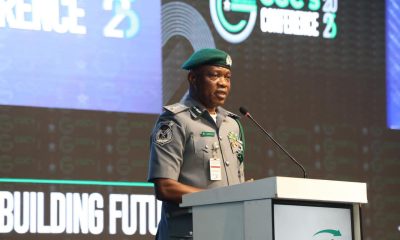
The Comptroller-General of Customs, Bashir Adewale Adeniyi, in a paper presented at the summit, said the Service was moving towards predictive border management powered by artificial intelligence, data analytics and digital platforms.
Adeniyi said the increasing sophistication of smuggling networks and complexity of international trade had made traditional dependence on physical inspection, paper documentation and manual processes inadequate.
He said AI would increasingly support risk profiling, anomaly detection, cargo targeting, valuation analysis, fraud detection, predictive enforcement and document verification.
The Customs boss highlighted the B’Odogwu Unified Customs Management System and the National Single Window as major components of the Service’s modernisation drive, saying their effective deployment could reduce physical intervention, speed up decisions and lower transaction costs.
He, however, warned that digital transformation must be accompanied by stronger cybersecurity, data protection and continuous training.
“The future Customs officer will therefore need to understand not only Customs law and procedures but also data, digital systems, artificial intelligence and analytical thinking,” he said.
Representing the Managing Director of NSML, Abdulkadir Kere Ahmed, the Manager, Maritime Centre of Excellence (MCOE), Bonny, Dr Effiong Ekanem-Attah, disclosed that 272 cadets had completed sea-time training under the company’s Seafarers Continuous Development Programme, while another 54 were either in college or onboard vessels.
He said NSML’s integrated approach, combining classroom training, simulation, sea-time, certification and industry experience, was helping to address Africa’s shortage of internationally certified maritime professionals.
The company, he added, had invested in advanced bridge and engine-room simulators and secured international accreditations to provide globally recognised maritime training in Nigeria.
Akin Omole, Managing Director, Ports Operations Strategic Unit, Dangote Industries Limited, called for stronger collaboration among government agencies, terminal operators, shipping companies and other stakeholders.
Omole said innovation should go beyond technology to encompass infrastructure, human capital and operational processes, stressing that sustained investment in training was essential to developing competent maritime professionals capable of deploying emerging technologies.
The Comptroller, Federal Operations Unit, Zone A, Nigeria Customs Service, Aliyu Gambo, also pledged stronger enforcement against smuggling and deeper collaboration with the media.
Gambo said intelligence-led enforcement and inter-agency cooperation remained critical to protecting Nigeria’s economic borders, facilitating legitimate trade and improving operational effectiveness.
He commended AMJON for recognising the contribution of FOU Zone A and said the recognition had imposed an additional responsibility on the unit to sustain professionalism, transparency and results.
President of AMJON, Vera Osokpo, said the summit was conceived to equip maritime journalists with the knowledge required to understand and report the transformation taking place in the industry.
Osokpo said maritime journalists occupied an important position as a bridge between policy and the public, adding that journalists could not effectively report innovation without understanding it.
“If we do not understand innovation, we cannot report it. If we do not understand the future, we cannot shape the narrative,” she said.
She thanked NSML, NPA, NIMASA, Customs and other stakeholders for supporting the summit, stressing that maritime development was not merely a sectoral issue but a national responsibility.
Osokpo also urged participants to use the knowledge gained from the summit to contribute to building a modern maritime industry capable of positioning Nigeria as Africa’s maritime hub.
The summit also featured awards recognising individuals and institutions for their contributions to the development of Nigeria’s maritime industry.
The convergence of views at the event underscored a common message: Nigeria’s maritime future will depend not only on acquiring new technologies but also on developing the skilled workforce, innovative institutions and collaborative systems required to deploy them effectively.











CCN, JDPC Jos mobilise women, Youths, PWDs for civic engagement in Plateau

‘No more writing 300 results’: Okorocha hails court ruling on Imo West Senate Ticket

Imo West Senate Race: Court rules for Okorocha, APC maintains support for Uzodimma
-

 Crime2 years ago
Imo police confirm arrest of journalist, ‘Nonsonkwa’ over alleged Cyberstalking, Incitement
-
 Business1 year ago
Kirikiri Lighter Terminal Customs achieves 63% revenue growth in first half of 2025, generates ₦89.2b
-

 Business1 year ago
Nigerians can now independently verify vehicle duty payment status online with ₦15,000
-

 Business3 years ago
Floating Naira: Imminent drawback to revenue as Customs Duty Exchange Rate rises again to ₦783.174
-
 Education8 months ago
Anambra leads South-east in education allocation ratio, as Imo ranks lowest
-

 Crime6 years ago
EFCC: “Why Magu’s confirmation was turned down by Senate”