
Business
NPA 2025 report shows rising exports, container boom

…As Lekki port takes lead
By Ezurike Ugochukwu
Nigeria’s seaports delivered their strongest performance in years in 2025, recording a 24.8 per cent surge in cargo throughput, a development widely viewed as reinforcing the Federal Government’s export-led economic diversification agenda.
According to the 2025 Operational Performance Report released by the Nigerian Ports Authority (NPA), total cargo throughput rose from 103.6 million metric tonnes in 2024 to 129.3 million metric tonnes in 2025, marking one of the most significant year-on-year increases in the country’s maritime history.

Managing Director of the NPA, Dr. Abubakar Dantsoho, described the performance as a defining milestone that strengthens Nigeria’s competitiveness along regional and global trade corridors.
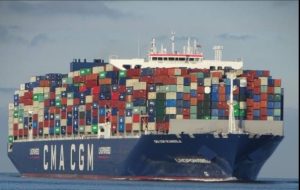
Exports Strength: While imports still account for a larger share of total cargo, the trade structure is gradually shifting. Exports contributed 39 per cent of overall throughput, compared to 59.2 per cent for imports, with transshipment accounting for 1.8 per cent.
Industry analysts say the steady rise in export volumes reflects policy reforms aimed at reducing reliance on crude oil and promoting non-oil exports through improved port efficiency and trade facilitation.
Container traffic: a key indicator of trade sophistication; climbed by 25.7 per cent to over 2.1 million Twenty-foot Equivalent Units (TEUs). Import-laden containers surged by 32.8 per cent, while export containers grew modestly by 3.1 per cent. Most notably, transshipment containers recorded an impressive 205.8 per cent increase, underscoring Nigeria’s ambition to position its ports as consolidation hubs for West and Central Africa.
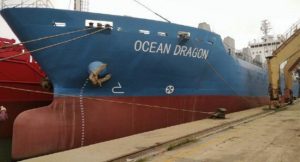
When big ship as Ocean Dragon berthed at Lekki Seaport
Emergence of Lekki : Port-level data reveal shifting dynamics within Nigeria’s maritime ecosystem. Lekki Port accounted for 40.6 per cent of total cargo throughput, emerging as the country’s leading gateway. Onne Port followed with 19.1 per cent, while Apapa Port handled 16.7 per cent.
Vessel profile statistics further highlight structural changes in shipping patterns. Lekki attracted the largest vessels, with an average Gross Registered Tonnage (GRT) of 55,712, closely followed by Onne at 53,022 GRT. Tin Can Island Port and Apapa received ships averaging 36,909 GRT and 33,251 GRT respectively, while Delta Ports handled vessels averaging 17,414 GRT.
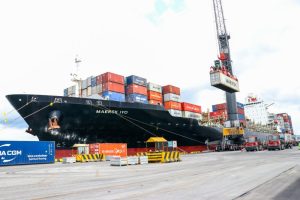
Onne port
Tin Can Island recorded the highest number of ship calls, accounting for 22.7 per cent of total arrivals. However, the increasing preference for Lekki and Onne by larger vessels signals a shift toward deeper-draft and more modern facilities capable of handling higher-value and higher-volume cargo.
Overall ship traffic increased by nearly 12 per cent to 4,477 vessels, indicating broad-based expansion across cargo segments.
Liquid bulk cargo – including petroleum products and chemicals – remained dominant at 54.7 per cent of throughput, while containerized cargo accounted for 24 per cent, reflecting gradual diversification into manufactured and processed goods.
Analysts note that rising vessel sizes, expanding container volumes and surging transshipment activity point to closer alignment with global shipping standards and evolving trade patterns. The sharp increase in transshipment cargo, particularly for neighbouring West and Central African markets, enhances Nigeria’s prospects of becoming a regional logistics anchor.

Minister of Marine and Blue Economy Gboyega Oyetola and NPA Managing Director Abubakar Dantsoho
Looking ahead, Dantsoho expressed optimism that the growth trajectory would be sustained through the Federal Government-approved port modernisation programme and the rollout of the National Single Window system.
The upgrade initiative aims to rehabilitate ageing infrastructure, deepen berths, expand cargo-handling capacity and deploy advanced digital platforms across Nigeria’s port network.
Stakeholders say successful implementation could reduce vessel turnaround time, shorten cargo dwell time and improve operational efficiency – key factors in sustaining export-led trade growth.
Taken together, the 2025 performance figures suggest Nigeria’s maritime sector is not only moving higher cargo volumes but also recalibrating its trade architecture, positioning the country’s ports as central pillars in its diversification and regional trade ambitions.















-

 Crime2 years ago
Imo police confirm arrest of journalist, ‘Nonsonkwa’ over alleged Cyberstalking, Incitement
-

 News6 years ago
Orthodox Anglican Church, not Same as Church of Nigeria- Bishop
-

 Business6 years ago
Pay-As-You-Go not applicable to pay TV – FCCPC
-

 Crime3 years ago
Pastor allegedly kills female member, prevents 20 year old daughter from attending burial
-

 News2 years ago
Ex-TCN Abuja GM, Nwaire wears cap of General Overseer Christian Life Gospel Assembly
-

 News6 years ago
Covid-19: Bishop Onuoha sues for equitable distribution of relief items