
Business
Coastal communities key to blue economy, Ehingbeti Hub tells govt
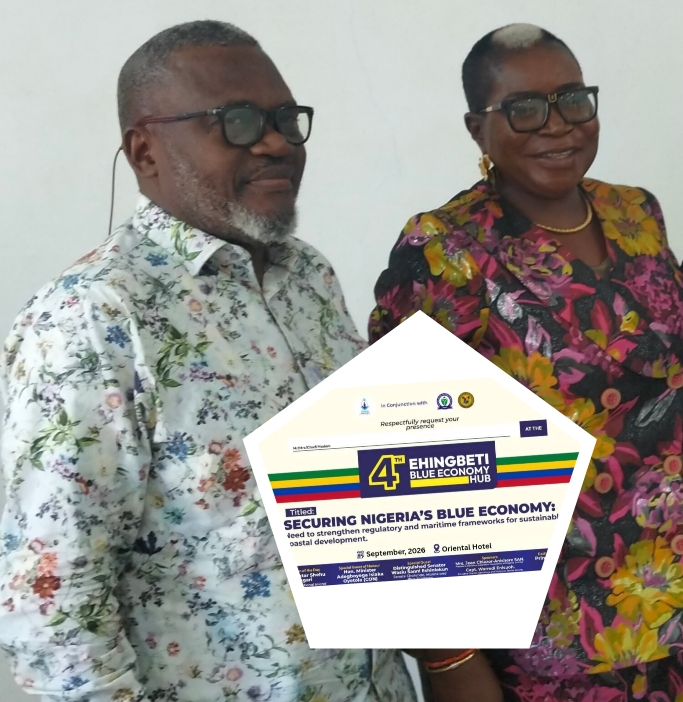
By Ezurike Ugochukwu
The Federal Government has been urged to place coastal communities at the centre of Nigeria’s blue economy agenda, with stakeholders warning that the country may not fully unlock the sector’s potential without harnessing the skills, knowledge and economic activities of people living along its waterways and coastline.
The call will form a major focus of the 4th Ehingbeti Blue Economy Hub, scheduled for September 17, 2026, at the Lagos Oriental Hotel.
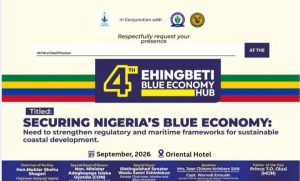
Themed “Securing Nigeria’s Blue Economy: Need to Strengthen Regulatory and Maritime Framework for Sustainable Coastal Development,” the forum is expected to examine the legal, regulatory and security challenges affecting coastal development and investment in Nigeria.

The event will be chaired by the Chairman of the Governing Board of the National Inland Waterways Authority (NIWA), Hon. Mukhtar Shehu Shagari, while the Minister of Marine and Blue Economy, Dr. Adegboyega Oyetola, will serve as Special Guest of Honour.
The two principal speakers are the President of the Maritime Arbitrators Association of Nigeria (MAAN), Chief (Mrs.) Jean Chiazor Anishere, SAN, and the Executive Director, Technical and Operations, Tantita Security Services Nigeria Limited, Capt. Warredi Enisuoh, who are expected to approach the theme from legal and maritime security perspectives.
Speaking ahead of the event, the Convener, Hon. Olaitan Williams, said coastal communities were not peripheral to the blue economy but constituted a critical foundation upon which several maritime activities and businesses were built.
Williams, who is also the Founder of Ocean Ambassadors Foundation (OAF), said the skills and indigenous knowledge of coastal residents should be integrated into government policies and investment programmes if the blue economy was to deliver meaningful economic opportunities and sustainable development.
She traced Ehingbeti to an indigenous coastal settlement that predates modern Lagos, noting that the history of the area demonstrated the longstanding maritime capabilities of its people.

According to her, the former Floating Bukka, a floating restaurant on the waterways, was among the early manifestations of the area’s maritime character, while the development of Ehingbeti and its surrounding areas was linked to the emergence of major maritime locations including Apapa, Tin Can Island and the Marina.
Williams said Nigeria’s blue economy policies must therefore go beyond formal maritime businesses to recognise rural fisheries, traditional boat building, diving and other indigenous livelihoods that sustain coastal populations.
“The low-hanging fruits of the blue economy are 100 percent from the coast,” she said, stressing that the priority should be to transform the existing skills and knowledge of coastal residents into productive economic opportunities.
She expressed concern that inadequate attention to the socio-economic conditions of coastal communities could undermine efforts to secure the waterways, noting that communities are often both the first victims of maritime insecurity and the first responders during boat accidents and other emergencies.
Williams also called for stronger legal and regulatory provisions for coastal development, arguing that a predictable framework was necessary to encourage investment and ensure that coastal communities benefit from the economic activities taking place around them.
Security, she added, remained another critical requirement for unlocking the potential of the sector.
She argued that investors and financial institutions would be reluctant to commit funds to inland waterways and coastal projects where security risks remained high.
Williams also identified illegal, unreported and unregulated (IUU) fishing as an area requiring stronger enforcement and legal backing, warning that Nigeria’s fisheries and marine resources must be protected against unlawful exploitation.
She advocated greater collaboration among government, investors, financial institutions and insurers, saying stronger regulation and improved security would enhance investor confidence and facilitate access to funding for blue-economy projects.
With Nigeria possessing extensive inland waterways and a vast coastline, Williams said the country had significant opportunities in maritime transportation, tourism, fisheries, logistics, boat building and other water-based economic activities.
She urged the government to leverage the expertise of traditional boat builders, divers, fishermen and other indigenous operators rather than allowing their skills to remain largely outside the formal economy.
She cited previous initiatives that provided training for young people in coastal communities, saying such programmes could be expanded to create employment, entrepreneurship and professional opportunities for the younger generation.
Williams explained that the Ehingbeti initiative began in 2023 following the establishment of the Federal Ministry of Marine and Blue Economy. The development inspired her to author The Renaissance of Ehingbeti in the Lagos Blue Economy, which was launched during the 2nd Ehingbeti Blue Economy Project.
She said successive editions of the Ehingbeti Maritime Hub had examined different aspects of the book, while the 2026 edition would focus specifically on legal and security frameworks as part of efforts to develop a practical blueprint for sustainable development of Nigeria’s inland waterways and coastal communities.
The forthcoming forum is therefore expected to bring together policymakers, maritime professionals, security experts, investors and representatives of coastal communities to explore ways of strengthening Nigeria’s maritime framework while ensuring that the people who live and work along the waterways become active participants and beneficiaries of the blue economy.
Williams said the ultimate objective was to build a blue economy that was not only commercially viable and secure but also inclusive, with coastal communities positioned as partners in Nigeria’s maritime development rather than left at the margins of it.







Seme–Krake: Nigeria, Benin Customs begin push for seamless border trade
AMJON Conference: NIMASA, Customs, NPA, NSML push innovation, digital skills for future-ready maritime sector

Customs: Discipline, character critical as 2025 recruitment screening enters final phase
-

 Crime2 years ago
Imo police confirm arrest of journalist, ‘Nonsonkwa’ over alleged Cyberstalking, Incitement
-
 Education7 months ago
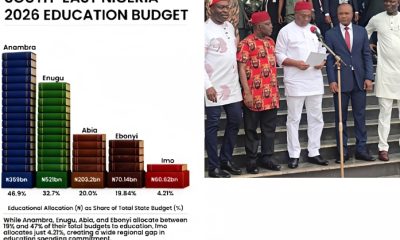
Anambra leads South-east in education allocation ratio, as Imo ranks lowest
-
 News6 years ago
Orthodox Anglican Church, not Same as Church of Nigeria- Bishop
-

 Business6 years ago
Pay-As-You-Go not applicable to pay TV – FCCPC
-

 Agriculture4 years ago
Environment Day: Foundation partners, FCMB, Chevron, harps on collective efforts on earth protection
-

 Crime3 years ago
Pastor allegedly kills female member, prevents 20 year old daughter from attending burial