
Law
Bus preaching ban, heavy fines spark fresh debate as CCN challenges FRSC Amendment Bill
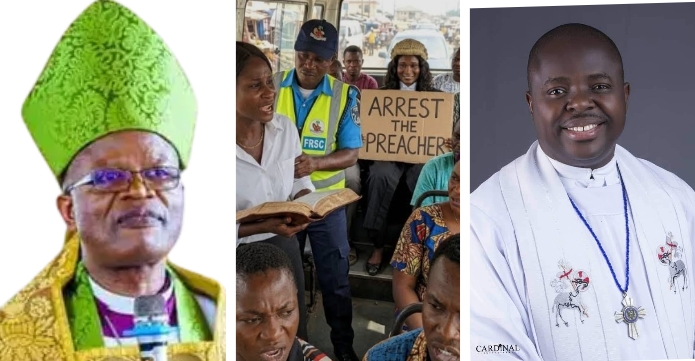
…Calls for wider consultations
By Ezurike Ugochukwu
The Christian Council of Nigeria (CCN) has called for a review of controversial provisions contained in the Federal Road Safety Corps (FRSC) Act (Amendment) Bill, 2026, warning that aspects of the proposed legislation could undermine constitutional rights while failing to address the socio-economic realities facing millions of Nigerians.
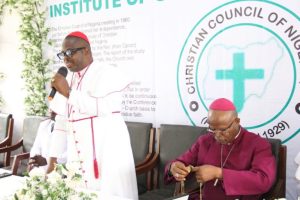
Dr Onyemara speaking
The Council, in a statement issued on Friday in Abuja by its General Secretary, Rt. Rev. Evans Onyemara, PhD, urged President Bola Tinubu, the National Assembly and other relevant stakeholders to undertake broader consultations before the bill is signed into law.

The Senate recently passed the amendment bill, which proposes a ₦100,000 fine for traffic light violations and a ₦50,000 penalty for hawking, trading or preaching in commercial buses, provisions that have generated widespread public debate.
While affirming its support for stricter road safety measures aimed at reducing accidents and improving discipline on Nigerian roads, the Christian body argued that the provision prohibiting preaching in commercial buses raises serious constitutional concerns.
According to the Council, placing peaceful religious preaching in the same category as hawking and trading could be interpreted as an infringement on the rights to freedom of religion and freedom of expression guaranteed under the 1999 Constitution.
 “For decades, commercial buses have served as platforms where Christians share brief messages of hope, repentance, encouragement and prayer with willing passengers. Any attempt to restrict such peaceful religious expression deserves careful scrutiny to ensure that constitutional freedoms are not eroded,” the statement said.
The Council stressed that while public safety remains important, regulations should not create the impression that Christian evangelism is being unfairly targeted.
Beyond the issue of religious freedom, the CCN also criticised the proposed sanctions against street hawkers, arguing that punitive fines alone cannot solve the underlying causes of roadside trading.
It noted that many Nigerians resort to hawking because of widespread unemployment, poverty and economic hardship, insisting that government should focus more on tackling the root causes rather than criminalising vulnerable citizens.
 “Poverty should not be criminalised,” the Council stated, recommending that authorities consider designated trading zones, economic empowerment initiatives and other humane alternatives where restrictions are necessary for public safety.
The organisation therefore appealed for extensive stakeholder engagement involving faith-based organisations, transport unions, civil society groups, road safety experts and representatives of vulnerable communities before the legislation is finalised.
It maintained that laws should protect lives while also safeguarding fundamental rights and preserving public confidence in democratic governance.
The Council added that effective legislation must strike a balance between enforcing road safety standards and respecting constitutional liberties.
“The Christian Council of Nigeria believes that legislation should unite rather than divide, protect rather than alienate, and promote both public safety and fundamental human rights,” the statement concluded.
 The FRSC Amendment Bill forms part of ongoing efforts to strengthen road traffic enforcement and improve compliance with safety regulations across the country.
However, some of its proposed provisions have continued to attract criticism from religious organisations, civil society groups and members of the public, who argue that the legislation should be refined to avoid unintended restrictions on constitutionally guaranteed freedoms while addressing Nigeria’s prevailing economic realities.
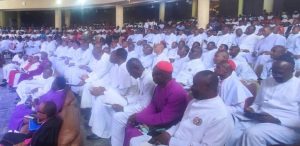
Christian Council of Nigerian members’ reunion










Seme–Krake: Nigeria, Benin Customs begin push for seamless border trade
AMJON Conference: NIMASA, Customs, NPA, NSML push innovation, digital skills for future-ready maritime sector

Customs: Discipline, character critical as 2025 recruitment screening enters final phase
-

 Crime2 years ago
Imo police confirm arrest of journalist, ‘Nonsonkwa’ over alleged Cyberstalking, Incitement
-
 Education7 months ago
Anambra leads South-east in education allocation ratio, as Imo ranks lowest
-
 News6 years ago
Orthodox Anglican Church, not Same as Church of Nigeria- Bishop
-

 Business6 years ago
Pay-As-You-Go not applicable to pay TV – FCCPC
-

 Agriculture4 years ago
Environment Day: Foundation partners, FCMB, Chevron, harps on collective efforts on earth protection
-

 Crime3 years ago
Pastor allegedly kills female member, prevents 20 year old daughter from attending burial