
Business
ANLCA @72: Nwokeoji, Adeniyi, Adedeji push technology, compliance in customs brokerage

By Ezurike Ugochukwu
The Association of Nigerian Licensed Customs Agents (ANLCA) has been challenged to accelerate the adoption of technology, artificial intelligence (AI) and stronger compliance practices as the association marked its 72nd anniversary in Lagos.
The call was made by key stakeholders, including ANLCA National President, Emenike Nwokeoji; Chairman of the Nigerian Revenue Service (NRS), Dr Zacch Adedeji; and Comptroller-General of the Nigeria Customs Service (NCS), Bashir Adewale Adeniyi, at the anniversary celebration held under the theme, “ANLCA: Celebrating a Legacy of Professionalism, Advancing Trade Facilitation and Shaping the Future of Customs Brokerage.”
The anniversary brought together government officials, regulators, Customs brokers, terminal operators, shipping and logistics stakeholders, former ANLCA presidents and other industry players to reflect on the association’s 72-year journey and the future of customs brokerage.


Nwokeoji said the future of the profession must be anchored on technology, efficiency and a more predictable trading environment, while calling for urgent reforms to reduce the cost and delays associated with cargo clearance at Nigerian ports.
He identified congestion, prolonged cargo examination, poor access roads, truck movement challenges, storage constraints, demurrage, detention and multiple regulatory interventions as some of the issues increasing the cost of doing business at the ports.
According to him, Nigeria’s ambition to become a major trading hub would remain difficult to achieve unless legitimate cargo could move through the ports with greater speed, transparency and predictability.
Nwokeoji also identified the National Single Window (NSW) as an important opportunity to simplify trade procedures, eliminate duplication, reduce unnecessary human intervention and lower the time and cost of cargo clearance.

He urged authorities to involve frontline port stakeholders in the implementation of the platform, noting that practitioners who work within the system daily understand its operational strengths, weaknesses and possible challenges.
The ANLCA president also stressed that revenue collection and trade facilitation should not be viewed as competing objectives.
He said a transparent and efficient trading environment could encourage investment, expand formal economic activity and ultimately improve government revenue, while cumbersome procedures could discourage legitimate businesses.

Adedeji, represented by the Director of the National Single Window Project, Tola Fakolade, challenged customs brokers to embrace technological change, particularly AI, while making compliance central to professional practice.
He said every generation of customs brokers had faced new systems and adapted, adding that AI was already being applied globally in areas such as document checking, classification support and risk analysis.
Adedeji identified three priorities for customs brokers: embracing change, adopting technology and championing compliance.
He explained that compliance protects government revenue through accurate valuation, proper classification and truthful declarations, while also protecting the reputation of the profession and the interests of clients.
He urged ANLCA to establish and communicate clear professional standards, encourage peer accountability and ensure members understand their obligations under applicable laws and procedures.
“Compliance should not be seen as a burden. It is your competitive advantage. In a world where trust is everything, the compliant broker is the one clients will choose,” he said.
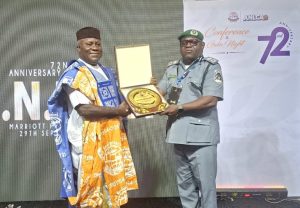
Nwokeoji presenting award to Comptroller Joe Anani
The Customs Comptroller-General, Adeniyi, represented by the Customs Area Controller of Tin Can Island Port Command, Comptroller Joe Anani, also emphasised the importance of technology, professionalism and compliance.
Adeniyi said effective customs regulation and trade facilitation could not be achieved by the NCS alone, stressing that customs brokers remained important partners in the process.
He noted that international trade was becoming increasingly digital, supply chains more complex and regulatory expectations higher, requiring customs agents to be knowledgeable, transparent and committed to complete and accurate information.
He urged practitioners to ensure proper documentation, timely submission of information and respect for Customs procedures and regulations, while collectively rejecting practices that undermine legitimate trade or expose businesses and the country to unnecessary risks.
The Customs chief said the Service would continue to advance automation, risk management, data-driven processes and stronger inter-agency collaboration.
He further urged ANLCA to promote voluntary compliance and improve the quality of information supplied to Customs for risk assessment, noting that technology would continue to transform how customs decisions are made and cargo assessed.
Adeniyi also called for continuous professional development, urging the association to invest in training and capacity building for its members while maintaining its role as a bridge between government and the business community.

The anniversary underscored a common message from government and industry stakeholders: the future of customs brokerage will increasingly depend on the ability of practitioners to combine professional competence and regulatory compliance with digital skills and technological adaptation.













-

 Crime2 years ago
Imo police confirm arrest of journalist, ‘Nonsonkwa’ over alleged Cyberstalking, Incitement
-

 Education7 months ago
Anambra leads South-east in education allocation ratio, as Imo ranks lowest
-

 News6 years ago
Orthodox Anglican Church, not Same as Church of Nigeria- Bishop
-

 Business6 years ago
Pay-As-You-Go not applicable to pay TV – FCCPC
-

 Agriculture4 years ago
Environment Day: Foundation partners, FCMB, Chevron, harps on collective efforts on earth protection
-

 Crime3 years ago
Pastor allegedly kills female member, prevents 20 year old daughter from attending burial